Case Study
How a Major Graduate School Pivoted from Branded to Non-Branded Paid Search and Won More Net-New Students
Scope
Overview
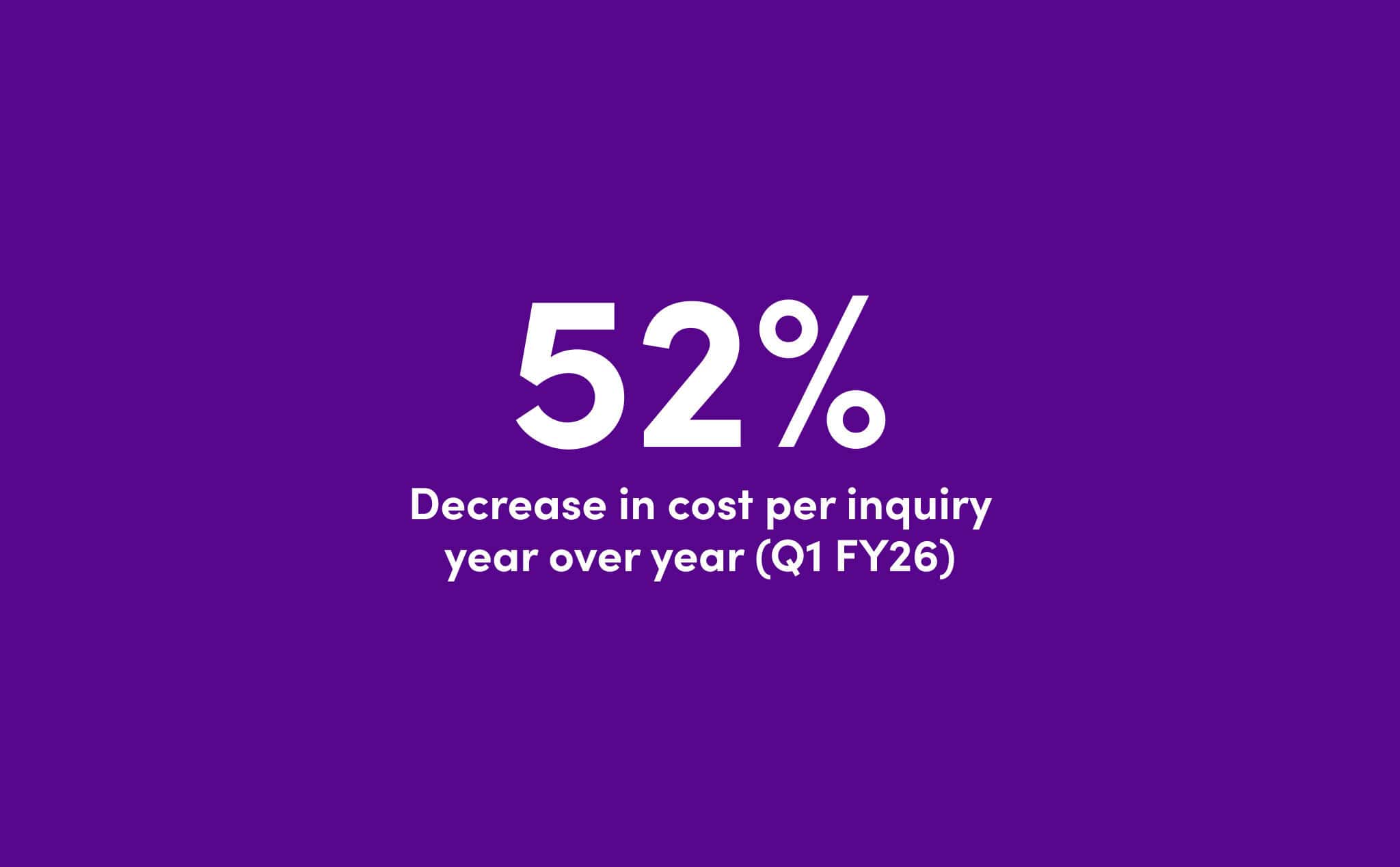
This case study explores how a major graduate school transformed its paid search strategy to drive meaningful enrollment growth. Faced with an account heavily reliant on branded keywords that generated strong dashboard metrics but limited net-new student acquisition, the institution partnered with Vital to rebuild its approach around non-branded search. By shifting budget toward program-focused campaigns, restructuring reporting, and maintaining a long-term growth mindset, the school increased non-branded inquiries by 61%, reduced cost per inquiry by 52%, and significantly expanded its applicant pipeline. This case demonstrates how higher education institutions can move beyond capturing existing demand and create sustainable enrollment growth through strategic paid media investment.
When Dashboard Metrics Look Great But Enrollment Doesn’t Grow
If your paid search reports show low cost per lead and high conversion rates while your enrollment numbers stay flat year over year, the account may be working harder for the dashboard than for the applicant pool. That’s the situation one graduate institution was in when they came to us. Their paid search account was inherited from a previous agency that had leaned heavily on branded keywords. On paper, the metrics looked clean. Cost per inquiry was low, conversion rates were high, and the dashboards told a story of efficient performance.
The problem was that the budget was largely capturing students who were already searching for the institution by name. Branded paid search is good at converting warm demand, but it does almost nothing to generate net-new student interest, and that’s exactly what the institution needed to grow enrollment.
We took over the account with a clear mandate: reduce reliance on branded campaigns, build out non-branded paid search around the programs the institution wanted to grow, and accept that the headline metrics would get worse before they got better.
A year and a half later, the data tells the story we expected. Cost per inquiry has come down significantly compared to the previous agency, non-branded inquiries have surged, and the funnel is now generating prospective students who would never have found the institution through brand-only campaigns.


A Top Graduate School Built on Brand Strength
Our client is a top-ranked graduate school in a major U.S. metropolitan area, offering a portfolio of master’s and doctoral programs across public service, public health, and policy disciplines. Their programs serve a national and international applicant pool, and their internal marketing team manages campaigns across multiple departments and degree formats.
As is common for high-profile graduate schools, they have strong brand recognition in their region and significant competition for net-new student attention outside it.


An Account Built for Efficient Reporting, Not Net-New Growth
The previous agency had built a paid search account that was efficient on paper but limited in what it could actually do for enrollment growth. Our audit surfaced four issues worth calling out:
A communication gap with leadership. Shifting strategy meant temporarily worse-looking dashboard numbers. We needed to set expectations clearly so the institution’s leadership could trust the long-term thesis.
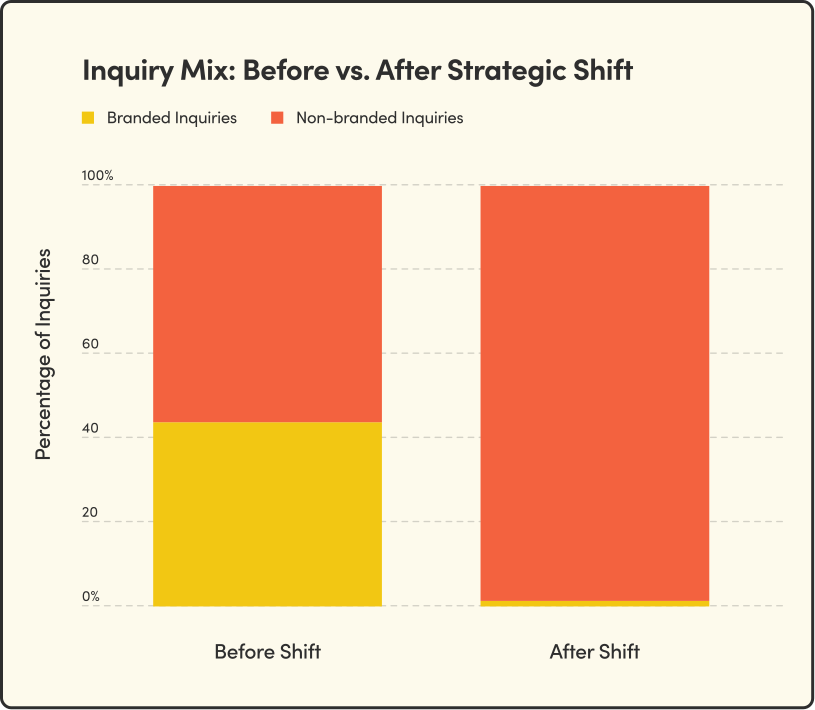
Heavy reliance on branded keywords. Roughly 41% of inquiries during the year before our engagement came from branded paid search, capturing prospective students who were already searching for the institution by name.
A funnel disconnected from net-new acquisition. Branded campaigns convert at low cost because they intercept existing demand instead of building it. The account had little infrastructure for reaching prospective students who hadn’t heard of the institution yet.
Headline metrics that masked the underlying issue. Low cost per lead and high conversion rates looked great in reports, but they reflected the cheap economics of branded search rather than genuine top-of-funnel performance.
Rebuilding the Account Around Net-New Acquisition
Rebuilding a paid search account around net-new acquisition takes time, and the first quarters are the hardest as metrics get worse before the strategy compounds.
Here’s how we approached the work:
Aggressive reduction of branded spend.
We deliberately pulled budget out of branded campaigns, knowing this would lower inquiry volume in the short term. By Q1 of the most recent fiscal year, branded inquiries had dropped from 41% of total inquiry mix to just 1%. That number isn’t a side effect. It’s a deliberate result of redirecting budget toward acquisition campaigns that build the funnel.
Non-branded program-level campaigns.
We built out new paid search campaigns organized around the programs the institution wanted to grow. Instead of bidding on the institution’s name, we bid on terms like the academic discipline, the credential, and the geography prospective students were searching for. The kinds of queries a prospective student runs when they’re shopping for programs in their field, like “public service graduate degrees in [major city]” or “public health master’s in [region],” rather than the queries someone runs when they already have a specific school in mind. These keywords are more competitive and more expensive per click, but they reach prospective students who don’t yet know about the institution.

Performance Max as a scaling lever.
Once the non-branded foundation was stable, we expanded into Performance Max campaigns for several priority programs. Performance Max became the primary growth driver for those programs, delivering record-low cost per inquiry while scaling volume sharply. This let us push net-new acquisition further without proportionally increasing spend.
Reporting that separated the two stories.
We restructured reporting so leadership could see branded and non-branded performance separately. That clarity was important. When cost per application went up in the early quarters, the report explained why. When non-branded inquiry volume started compounding, the report showed exactly where the growth was coming from. Trust in the strategy held because the data was transparent.
Patience through the matriculation lag.
Inquiries don’t become applications overnight, and applications don’t become enrolled students overnight either. We made sure the institution understood that prospective students generated through non-branded paid search would take time to mature through the funnel, and that early-quarter application and deposit numbers shouldn’t be compared directly against a prior year built on warm branded traffic.

The Numbers Turned Once the Strategy Compounded
The strategy played out the way we expected. After an early period where dashboard metrics looked worse, the underlying numbers turned and kept turning. Here’s how the account performed once the strategy took hold.
Top of Funnel Volume Climbed While the Mix Flipped
Branded inquiries dropped from 41% of total mix to 1% by Q1 of the most recent fiscal year, and the account replaced that volume with net-new prospective students sourced through non-branded campaigns.
- Branded inquiry mix: 41% to 1% (deliberate reduction)
- Non-branded inquiries (full prior fiscal year YoY): +61%
- Total inquiries (full prior fiscal year YoY): +8%, despite the dramatic strategic shift
- Total inquiries (most recent quarter YoY): +180%
Lower Cost Per Inquiry and Stronger Down-Funnel Conversion
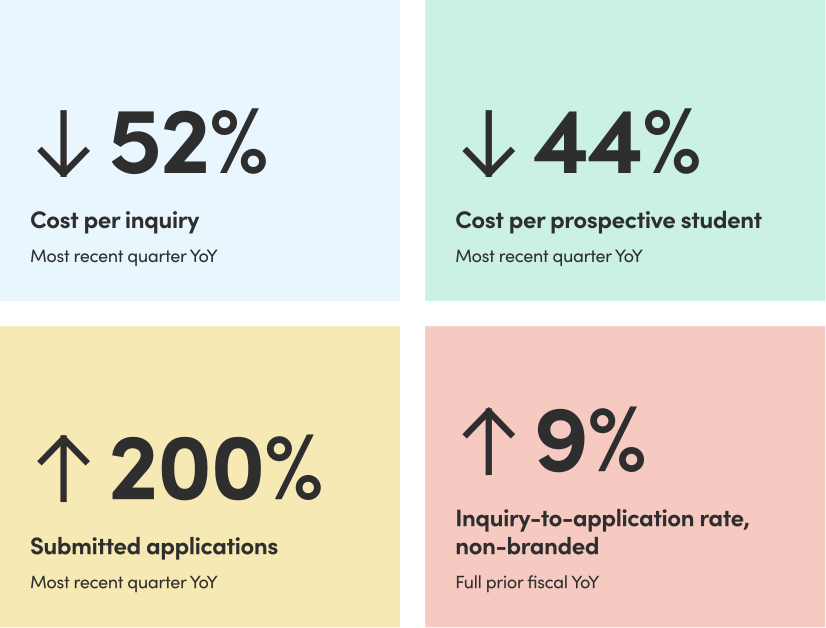
Cost per inquiry fell 52% year over year in the most recent quarter, and the inquiries we were generating moved through the funnel at higher rates than the previous mix had.
- Cost per inquiry (most recent quarter YoY): -52%
- Cost per prospective student, all stages combined (most recent quarter YoY): -44%
- Inquiry-to-application rate, non-branded (full prior fiscal year YoY): +9%
- Submitted applications (most recent quarter YoY): +200%
- Enrolled students (most recent fiscal year YoY):
The Trade That Paid Off
Branded paid search will always look efficient because it converts demand that already exists. The trap is mistaking that efficiency for growth. For graduate institutions trying to expand their applicant pool beyond the prospective students who already know the brand, non-branded paid search is the only path forward, and the early metrics will look harder before they look better.
Our partnership with this graduate school has worked because their leadership held the line through early quarters when the dashboard took a temporary downward turn. They asked tough questions, pushed for clear reporting, and gave us the runway to let the strategy compound.
If you’re inheriting a paid search account from another agency, or your enrollment numbers aren’t keeping pace with what your dashboard says about lead generation, this is the kind of pivot that pays off when the team holds the line.
Get Ready to Write Your Own Success Story
Start the conversation about how Vital can help your higher education institution maximize the ROI of your marketing spend.