Case Study
How a Graduate University Boosted Paid Search Performance With Program-Specific Landing Pages
Scope
When Your Programs Compete, Generic Landing Pages Hold You Back
When a private graduate university in a major metropolitan area came to us looking to sharpen their paid search results, the diagnosis was straightforward. Several of their highest-priority programs either had no landing page at all or shared a combination page with a similar program. Paid traffic was getting routed to general program pages or to combo pages that asked one piece of creative to speak to two different audiences. The result was a clear gap between what users searched for, what they saw in the ad, and where they landed.
We partnered with the institution to audit their paid search funnel, identify the programs that needed their own landing pages, and build new pages built around each program’s audience. Within months of launch, every program we touched saw double or triple-digit lifts in inquiry volume and significant reductions in cost per inquiry.

248%
Increase in inquiries for one program
after launching its own landing page

A Graduate Institution With a Big Catalog and a Bigger Mandate
Our client is a private graduate university located in a major U.S. metropolitan area, offering a wide mix of master’s and doctoral programs across business, health sciences, psychology, education, and the arts. Their portfolio includes both on-campus and online formats, with several specialized programs that serve niche audiences alongside larger flagship offerings.
With a graduate enrollment in the low thousands and a portfolio of more than 100 programs across multiple departments, their internal team manages a sizable catalog with limited resources. That makes prioritizing where to invest in landing page work a real challenge, and a familiar one for graduate institutions of similar size.
Where the Paid Search Funnel Was Breaking Down
- No landing pages for some programs. Several programs were sending paid traffic directly to their academic program pages, which are built for general site visitors and aren’t optimized for paid search conversion.
- Combination pages doing double duty. Programs with closely related variants, such as an MS and an MBA in the same field, shared a single landing page that tried to speak to two distinct audiences at once.
- Misalignment between keyword, ad, and landing experience. When the keyword and ad copy spoke to one specialization but the landing page covered multiple, prospective students had to do extra work to find what they actually searched for.
- Form fill rates that didn’t reflect ad spend. Strong ad performance wasn’t translating into qualified inquiries because the landing experience created friction at the conversion point.
Building Landing Pages That Match Search Intent
Our paid media team worked alongside our design and content teams to build a focused landing page program that matched the structure of the campaigns themselves. The four priority programs included a mix of on-campus and online formats, which meant each landing page also had to reflect how prospective students would actually experience the program. The goal was to give every priority program a landing page that mirrors the keyword, the ad, and the user’s intent at the moment they click.
Here’s how we approached it:
1. Audit and prioritization
We started by auditing the full paid search account and mapping every active campaign to its current landing destination. From there, we identified the programs that would benefit most from their own pages. Priority went to programs with strong search volume that were either pointing at a generic program page or sharing real estate on a combo page.

2. Net-new landing pages for under-served programs
For programs without their own landing page, we built one from the ground up. Each new page was structured around the specific program’s audience, with messaging, proof points, and form fields tailored to the kind of prospective student that program attracts. This included high-priority programs in the health sciences and psychology departments that had previously been routed to academic program pages.

3. Breaking out combination pages
For programs sharing a combo page with a similar offering, we created separate landing pages so each variant could speak directly to its own audience. An MS landing page can lead with research and clinical practice positioning, while an MBA landing page in the same field can lead with leadership and business strategy. Splitting these out allowed for tighter keyword targeting and a cleaner one-to-one match between ad and landing experience.

4. Calibrated messaging for conversion
Each landing page was written to give prospective students enough information to feel informed and enough open questions to want a conversation. We kept tuition figures off the page entirely. Scholarship details stayed light. Program outcomes and curriculum highlights stayed prominent. Prospective students saw the why of the program on the page and had a clear reason to submit the form for the rest.

5. Aligning the full funnel
Beyond the page itself, we made sure the keyword, ad copy, landing page, form, and follow-up nurture sequence all reinforced the same message. When every step of the funnel speaks the same language, prospective students feel confident they’re in the right place, and conversion rates follow.

Double and Triple-Digit Lifts Across Every Program
We launched the new landing pages in September, and within weeks the data was telling a consistent story across every program. The pattern was the same whether the program had no landing page before or was sharing a combo page with a similar offering.
PPC Goals
The client wanted to focus their PPC investment on two main goals:
- Generate more quality early-stage leads
- Boost brand awareness
Because this client is well-known within the fintech market, they were already capturing a large share of late-stage, sales-ready leads. But, without an effective strategy to increase brand awareness and drive leads at the top and middle of the sales funnel, their potential for growth was stagnating. Along the way, we cut our client’s cost-per-lead (CPL) by more than 59%.
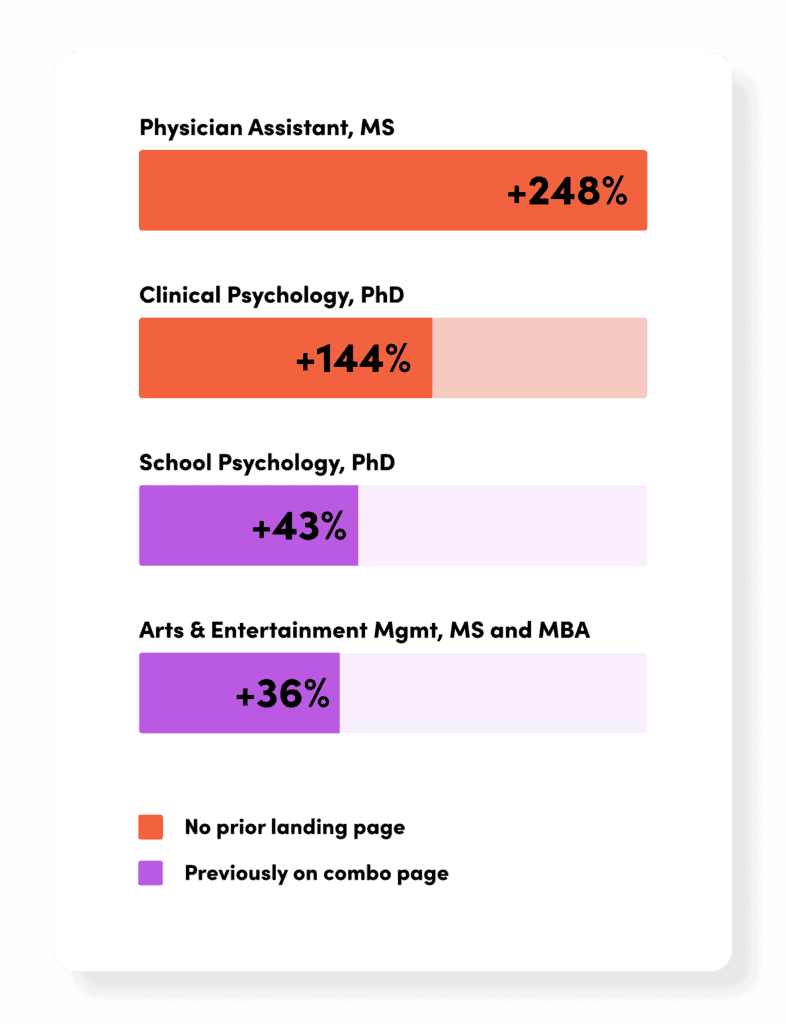
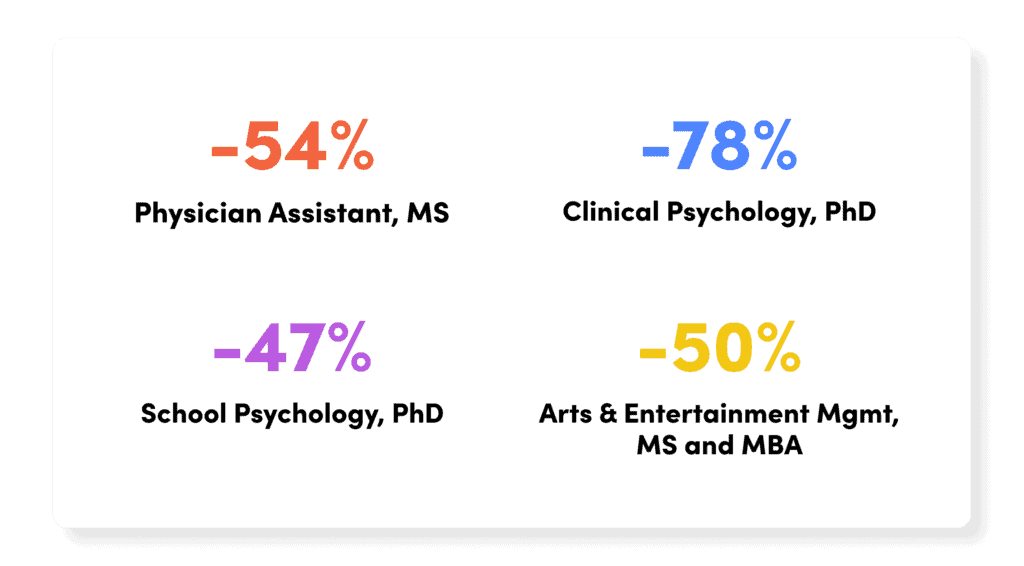
- Physician Assistant, MS (no prior landing page): +248% inquiries, +95% conversion rate, -54% cost per inquiry
- Clinical Psychology, PhD (no prior landing page): +144% inquiries, +157% conversion rate, -78% cost per inquiry
- School Psychology, PhD (previously on combo page): +43% inquiries, +30% conversion rate, -47% cost per inquiry
- Arts and Entertainment Management, MS and MBA (previously sharing combo page): +36% inquiries, +77% conversion rate, -50% cost per inquiry
Lower Cost Per Inquiry on Every Program We Touched
Cost per inquiry dropped by between 47% and 78% across the four programs, even as inquiry volume climbed. Better page-to-search alignment meant fewer wasted clicks and a higher share of paid traffic converting to qualified inquiries.
The Bottom Line
The lesson here isn’t complicated, but it’s one a lot of higher education paid search programs miss. If you’re investing in paid search for individual programs, every priority program deserves its own landing page that mirrors the search intent. Combo pages and academic program pages can work in a pinch, but they leave performance on the table because they ask prospective students to do work the landing page should be doing for them.
Our partnership with this graduate university continues to expand as we apply the same approach to additional programs across their catalog. The institution’s team has been a thoughtful collaborator throughout, sharing audience insights, prioritizing the right programs, and giving us the latitude to test and refine. Their willingness to invest in the landing page infrastructure is a big part of why the numbers look the way they do.
If your priority programs are still pointing paid traffic at academic catalog pages or sharing combo pages with closely related degrees, the fix is faster and more profitable than most teams expect.

Get Ready to Write Your Own Success Story
Start the conversation about how Vital can help your higher education institution maximize the ROI of your marketing spend.