Key Takeaways
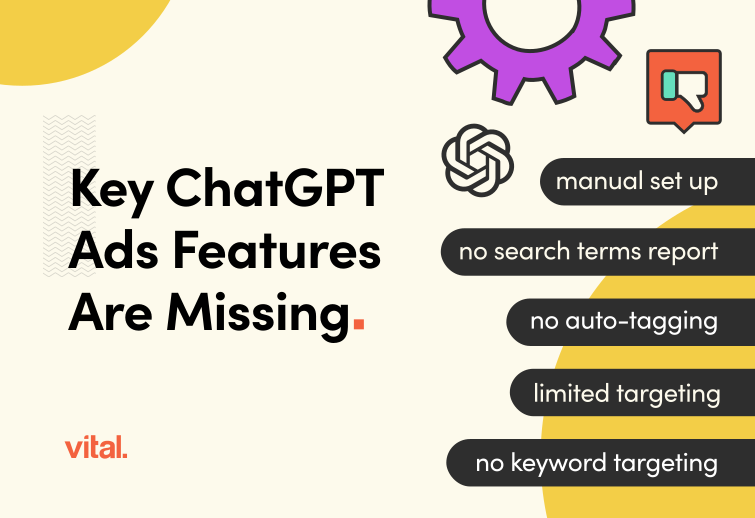
- ChatGPT’s ad platform is very much in the early stages. Advertisers used to Google or Meta’s automation should expect a much more manual, hands-on experience.
- All UTM tracking for ChatGPT ads must be set up by hand. There’s no auto-tagging or built-in UTM builder, making a documented tagging convention essential.
- Automated bidding doesn’t exist yet. ChatGPT ads run entirely on manual cost-per-click, which means campaigns require active daily management.
- Targeting in ChatGPT is guided by “context hints,” not keywords, and these best practices are still being figured out.
- There’s no search terms report, which means no visibility into which user prompts are triggering their ads, making it difficult to refine targeting or learn from performance.
- Treat ChatGPT ads as a learning investment, not a performance channel. There are real upsides, but the tooling isn’t mature enough yet to optimize the way you would on established platforms.
ChatGPT ads are one of the more interesting media bets on the table right now — first-mover window, premium intent, almost no competition. The speed at which OpenAI is actively writing the playbook with early advertisers is shaping the field of LLM ads, and the brands that figure out how to use it effectively will benefit the most.
But having a strategy is one thing. Working inside the actual ad platform is another. After spending real time in the beta, here’s what advertisers need to know about ChatGPT ads before they write a check.
First, the short version: this is an extremely early product, and it shows. If you’re used to the level of automation and reporting Google and Meta have spent twenty years building, roll your sleeves up, because you’re going to have to get your hands dirty again.
1. No internal UTM setup. You’re doing this by hand.
There’s no UTM builder, no auto-tagging, no template you can apply at the campaign level. Every UTM parameter must be manually attached to your landing page URLs. So you’re hard-coding strings like this for every ad:
This is fine for a small account with a handful of ads. It’s a nightmare at scale, and it’s exactly the kind of operational friction that produces bad data when someone fat-fingers a parameter at 4 p.m. on a Friday. Build a tagging convention document before you launch anything, and don’t deviate from it.
2. No automated bidding. Welcome back to manual CPC.
This was the one that genuinely surprised me. We’re back to manual cost-per-click bid strategies. No Max Conversions, no Target Cost Per Action, no Max Conversion Value, no Target Return on Ad Spend. None of the bidding automation that has defined paid media for the last half a decade.
Conversions can be tracked, but only for reporting. They don’t feed any optimization layer because there isn’t one yet. Every bid is something you set and adjust by hand based on what you’re seeing in the data.
The irony is not lost on anyone: the most advanced AI platform in consumer technology is selling ads through a bidding system less sophisticated than what Google rolled out years ago. It’ll get there. But right now, you’ll need to plan for active daily management, not set-and-forget.
3. Targeting is “context hints,” and nobody knows what works yet.
Targeting at the ad group level is built around what OpenAI calls “context hints.” Their own definition: “Describe the conversations, topics, or keywords where your products or services may be relevant; these hints guide matching but aren’t exact-match targeting rules.”
What we don’t know yet, and what nobody in the beta seems to have a confident answer on:
- Do short keywords work better, or longer-tail phrases?
- Do prompt-style terms (“how do I …”) outperform topical nouns?
- How specific is too specific before the model stops matching at all?
We’re A/B testing approaches across campaigns, but the lack of reporting (more on that next) makes it hard to draw clean conclusions.
4. No search term or prompt report. You’re flying blind on intent.
This is the biggest gap, and it ties directly to the targeting problem. There is no equivalent to a Google search terms report. You cannot see which prompts in ChatGPT triggered your impressions or clicks.
This breaks a lot of things at once; you can’t:
- Tell which actual user queries are driving performance.
- Identify overlap between ad groups or campaigns.
- Refine context hints based on real prompt data.
- Build negative term lists with any precision.
- Surface high-intent prompts to inform creative or landing page copy.
For a channel built around conversation, the absence of conversation-level reporting is a real problem. It means optimization is happening on lagging indicators (clicks, conversions, cost) instead of leading ones (prompt patterns, intent signals). You can still run profitable campaigns. You just can’t learn from them at the speed you’re used to.
So what does this mean for advertisers?
A few rules I’d give anyone walking into the beta right now:
- Treat it like a learning budget, not a performance channel. The infrastructure isn’t there yet to optimize the way you would on Google or Meta. What you’re buying is reps, data, and a head start on whatever the platform becomes when the tooling catches up. You should not pull budget from profitable platforms to spend on this platform.
- Document everything manually. Spreadsheet your context hints, your bid changes, your creative variants, and your landing page versions. The platform won’t remember what you tried. You will need that record when OpenAI rolls out reporting, and you want to understand what worked retroactively.
- Don’t scale until you have a baseline. With no automated bidding and no prompt-level reporting, scaling spend without understanding what’s driving performance is how you turn a high-CPM channel into an expensive lesson. Start small, get a feel for how context hints behave, then scale.
- Push OpenAI for the missing features. The advertiser relationships being built right now will shape what gets prioritized. Beta access is also a feedback channel. Use it.
The platform will catch up. But anyone betting on ChatGPT ads in 2026 needs to understand that you’re getting in early, which means you’re getting in incomplete. The CPMs are priced in scarcity, not maturity.
That’s the trade-off. It’ll be worth it for some brands. Worth waiting out for others.