Most of what you’ll read about ChatGPT ads is a polite rewrite of OpenAI’s announcement emails. We’ve actually been running campaigns on the platform, so here’s the view from inside. We’ll start with two things our own testing taught us about creative, then we’ll walk through what’s changing on the platform and why it matters for you.
Two Things We’ve Learned About Ad Creative
Creative in ChatGPT doesn’t behave like search or social. The placement is small, the format is rigid, and the habits you’d carry over from Shopping or Meta will work against you. Two findings have held up across everything we’ve tested.
1. Write to the Truncation Point, Not the Limit
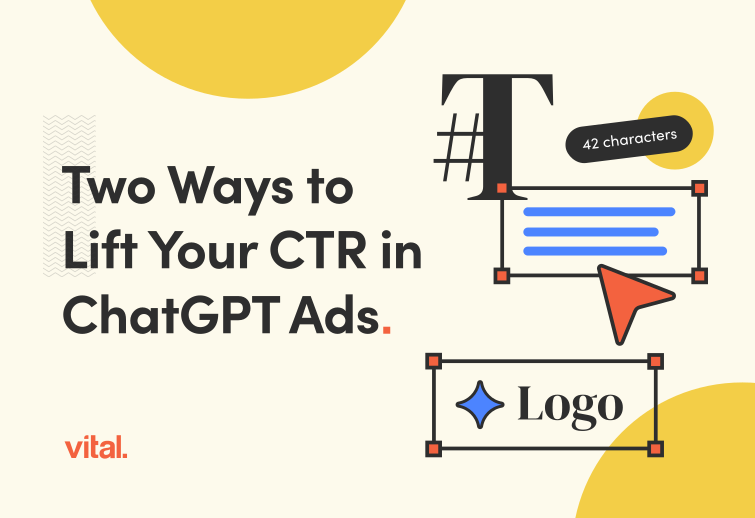
You should know that the stated limits aren’t the real limits. Titles allow 50 characters but get cut off past 24. Descriptions allow 100 but get cut off past 48 characters. So the character numbers that actually matter are 24 and 48.
Here’s the kicker: we saw a 100 percent jump in click-through rate (CTR) on ads that stayed inside the truncation point. That’s double the clicks, from one change.
The reason’s simple. An ad that gets cut off looks broken. It buries the part you wanted people to read, and it reads as careless. When the whole message fits, the ad looks finished and the point lands. Most advertisers will write all the way to the 50- and 100-character limits, because that’s what the field allows — and they’ll lose half their message, and a chunk of performance, right along with it.
So front-load everything that matters into the first 24 characters of your title and the first 48 of your description. If you do write to the full limit, treat the rest as a bonus you may never get to use.
2. Logos Are Beating Product Images
This one goes against instinct. On Shopping and Meta, the product image is the ad. In ChatGPT, the brand mark is winning.
We’re seeing 14 percent higher CTR on ads that use a logo instead of product or service imagery.
Why’s this happening? The image space on these placements is tight, which means you can’t run high-quality images. But that’s okay, because you’re not selling the product in the creative — you’re earning the click. The job of a ChatGPT ad is to grab attention fast, and a clean, recognizable logo does that better than a detailed product shot that turns to mush at a small size.
A logo’s built to be read in an instant. A product photo isn’t.
Here’s What’s Changing on the Platform
Product Feed Ads Are Coming for Ecommerce
OpenAI is rolling out feed-based shopping ads. In a feed-based ad, a retailer uploads its product catalog, and the system builds the ads straight from the data, pulling in product names, images, and attributes. No more building ads one at a time. It’s the Google Shopping model, where a structured feed powers the ads and the platform assembles them for you.
For any catalog advertiser, this removes the biggest bottleneck. Building campaigns by hand never worked at thousands of stock-keeping units (SKUs). Now it doesn’t have to.
Multi-Advertiser Placements, and a Real Auction
Until now, ChatGPT ads were close to fixed placements. That’s changing as OpenAI is testing multi-advertiser placements on a small slice of ads. Instead of one ad under a response, multi-advertiser placement can show several relevant ads together. Eligible ads get priced through a second-price auction.
This is a major structural change; everything else here is housekeeping by comparison. Putting multiple advertisers in a single slot and pricing it through a second-price auction is the start of a real marketplace.
You can expect more ads per prompt, bid competition, and the pricing dynamics we already know from Google and Meta.
Ads Manager Is Catching Up to the Majors
A run of updates is filling in the controls that every mature platform already has. Finally, you’ll be able to:
- Switch existing campaigns from lifetime budgets to daily budgets
- Clone a cost-per-thousand-impressions (CPM) campaign to cost-per-click (CPC) bidding in one click
- Set a custom max bid on impression-based campaigns instead of a fixed one
- Make bulk edits to campaigns, ad groups, and ads right in the user interface (UI), on top of the existing comma-separated-values (CSV) bulk edits
- Run daily budgets as average daily budgets with weekly allocation, so pacing has room to flex
- Expand targeting past the U.S., Canada, Australia, and New Zealand to the U.K., Japan, South Korea, Brazil, and Mexico
One thing that stands out here is the one-click CPM-to-CPC conversion. OpenAI is steering advertisers away from impression buying and onto performance bidding, which aligns with the CPC rollout and the cost-per-acquisition (CPA) models reportedly in the works.
Where This Leaves You
The ChatGPT platform is becoming something you can operate at scale rather than hand-build. These changes are a step toward making ad creation easier across the board.
However, measurement still lags as there’s no search term data, and UTM tracking is still not native. It’s anyone’s guess when that will change.
The big takeaway is the brands that win early won’t be the ones waiting for OpenAI to fix attribution. They’ll be the ones testing now, learning that the creative rules here are their own, and building a track record before the auction gets crowded.
If you want a head start, that’s exactly where we’d spend it.