Graduate and continuing education marketing is a high-stakes discipline operating under conditions that most marketing frameworks weren’t designed for. Budgets are limited, often fragmented across programs, and rarely protected from institutional cost-cutting. Tuition revenue is significant — which means the pressure to justify every dollar is constant — but the path from a paid media click to an enrolled student can span twelve to eighteen months, making ROI genuinely difficult to demonstrate in the timeframes leadership typically demands. To put this into perspective, in a recent data pull for one of our large graduate program clients, the average timeline from an information request submission to application alone was 165 days.
The result is a familiar tension: You’re expected to hit ambitious enrollment targets with resources that require careful, strategic allocation and a clear rationale at every turn.
That’s where this guide comes in.
It’s designed to help you navigate that tension and make a case for smarter media investment to skeptical leadership. You can use it in three ways:
- As a planning tool when you’re building or rebuilding your paid media budget
- As a presentation resource when you need benchmark data and strategic frameworks to back up your recommendations
Or
- As a recurring reference as platforms evolve, costs shift, and your program mix changes
No matter how you use it, the goal throughout is the same: to give you the clarity, the language, and the evidence to spend smarter and advocate more effectively.
Where the Money Goes in 2027 (and Why It’s Changing)
The Paid Media Landscape for Graduate Programs
Graduate enrollment marketing has never operated in a simple media environment, but its complexity has reached a new level. Between tightening institutional budgets, a more skeptical prospective student, and a platform ecosystem that is constantly reinventing itself, the margin for guesswork is at an all-time low. Marketers who still rely on intuition or historical precedent to guide allocation decisions are leaving performance, and enrollment, on the table.
Today’s grad program marketer must navigate five core paid media platforms, each with a distinct role, cost structure, and audience behavior. These are:
- Google Search remains the workhorse of graduate enrollment marketing. When a working professional searches for “online MBA with flexible scheduling” or “MPH programs for nurses,” search captures that moment of intent and converts it more efficiently than any other channel. It’s also where most marketers concentrate the bulk of their budget, which makes it the most competitive channel in the mix. But despite the competition, it’s still often the clearest path to positive ROI.
- Meta (Facebook and Instagram) is well-suited for keeping your program top-of-mind among prospects who’ve already shown interest, thanks to its broad reach and visual storytelling capabilities. It’s also great for driving awareness among adjacent audiences for certificate and continuing ed programs.
- LinkedIn is the premium option in the mix. Even though it comes with higher CPM (cost per mille, or cost per thousand), it’s uniquely capable of targeting by job title, industry, employer, and career stage. For executive programs, employer-aligned degrees, and anything positioned around professional advancement, LinkedIn’s audience precision is worth the cost.
- Programmatic/Connected TV (CTV) plays the long game. Strategic display and video placements build brand familiarity with working adults who may not be in active search mode yet. CTV in particular has grown rapidly as a channel for reaching professionals during evening hours.
- Open AI (ChatGPT) Ads is reshaping how prospective students research programs. As more and more of them turn to conversational AI to ask questions like “what’s the best online for someone in healthcare?,” ads placed within that conversation capture a form of high-intent research that increasingly takes place outside of traditional search.
What’s Changed Since 2025?
In the past year, the paid media landscape has shifted in four noteworthy ways:
- Privacy-first targeting has reshaped audience strategy. The depreciation of third-party cookies, expanded consent requirements, and platform-level data restrictions have made it harder to track the full prospect journey. First-party data — inquiry forms, CRM lists, and event registrations, for example — has become the most valuable targeting asset a program can hold. Marketers who already built clean, segmented audiences have a measurable advantage.
- AI-generated ad placements are no longer a test. Google’s Performance Max and Meta’s Advantage+ campaigns now use machine learning to dynamically assemble ad creative, select placements, and optimize bids with minimal human input. While these tools can deliver strong efficiency gains, they also reduce transparency. When using them, enrollment marketers need to weigh what they’re giving up in control in exchange for what they gain in automation.
- Attribution has gotten harder (and more important). As cross-device behavior has grown and walled gardens have tightened their data, last-click attribution increasingly misrepresents which channels are actually driving enrollment decisions. Programs that continue to optimize solely on last-click cost-per-lead risk starving the upper funnel channels responsible for driving those leads in the first place.
The attribution challenge has also been part of what’s fueling the rise in “ghost applications.” These ghost applications can be coming from various marketing sources, and certain advertising channels may be underreporting success due to this.
Multi-touch or position-based attribution models, even imperfect ones, now provide a more honest picture of channel contribution.
- Platform pricing has increased across the board. CPM and CPC (cost per click) have both risen since 2025, but the increases haven’t been uniform. LinkedIn’s already-premium CPM has climbed further, Google Search CPC in competitive program categories have reached levels that make underfunded campaigns effectively invisible, and Meta’s pricing has risen even as its targeting precision has decreased due to privacy restrictions. For graduate enrollment marketers working within strict budgets, this means fewer impressions, clicks, and leads from the same nominal spend, making allocation discipline more consequential than ever.
This doesn’t mean you can’t win. It just means there’s less room for error. To stay competitive, optimized campaign structures, dialed-in landing pages, and precise keyword targeting are what separate programs that still find efficient enrollments from those that get priced out.
Why Targeted Campaigns Outperform Broad Spending
The instinct to maximize reach and get your program name in front of as many people as possible is understandable, but isn’t the best strategy given the audience. Prospective grad students aren’t mass-market consumers. They’re working adults with specific career goals, time constraints, obligations, and a long consideration cycle. Generic messaging, no matter how far reaching, produces generic results: high impression volume, weak engagement, and leads that aren’t likely to convert.
Highly targeted campaigns — built around program-specific intent signals, carefully segmented retargeting audiences, and channel strategies matched to where a prospect is in their decision journey — are much better positioned to outperform broader approaches.
Where the Industry Currently Spends
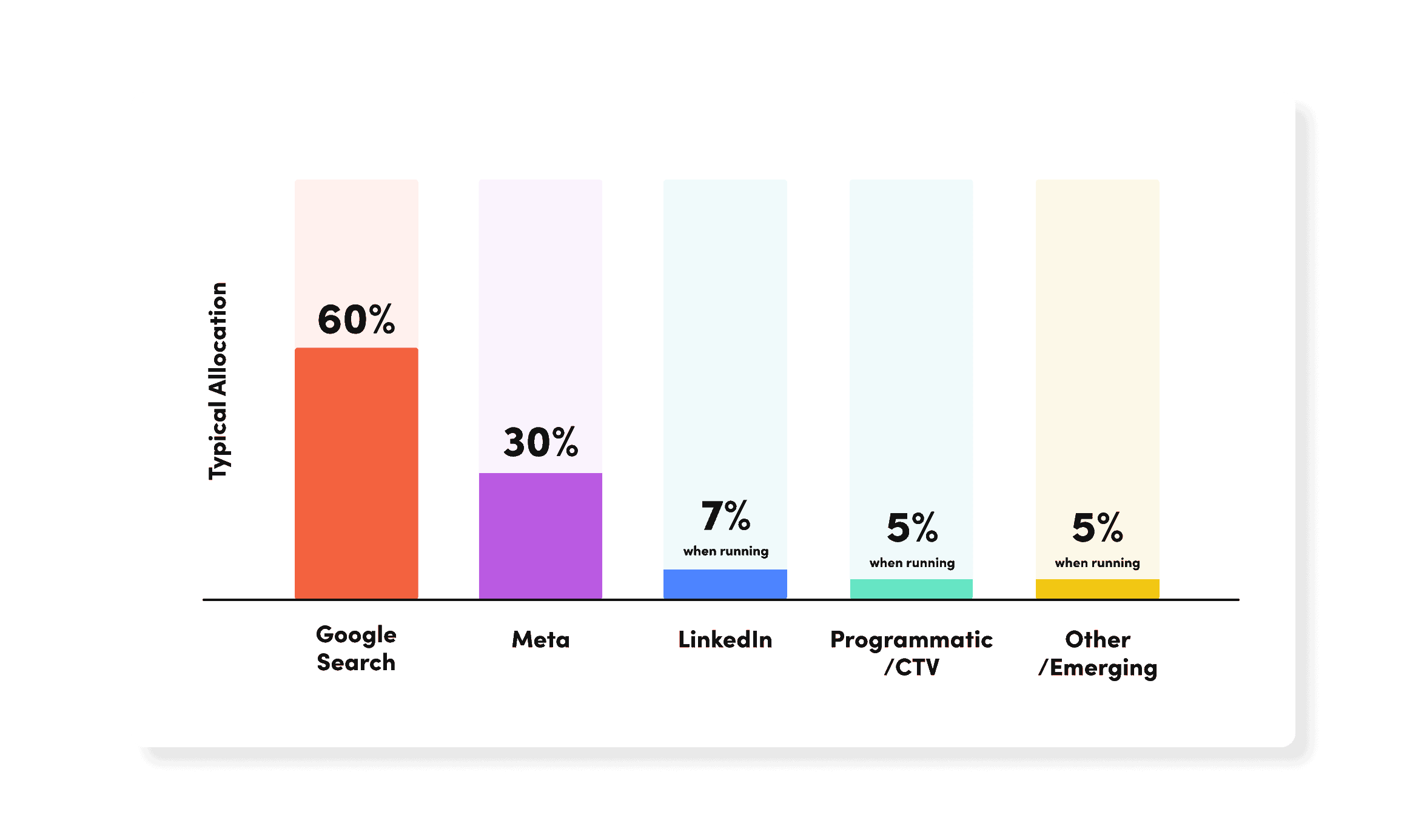
Budget allocation patterns across higher ed marketing vary by institution type, program portfolio size, and internal sophistication. Overall, here’s what we’ve been seen among our current graduate level ad campaigns:
The Recommended Allocation Model
The typical allocation above reflects habit and inertia more than strategy. Google Search earns its 60% share, but Meta’s 30% is a legacy default for most, meaning that it’s a channel that programs tend to stick with because it’s familiar, not because it necessarily outperforms others on a per-enrollment basis.
Meanwhile, LinkedIn is frequently underfunded relative to its actual return. Half of our clients aren’t running LinkedIn ads at all, and among those who are, ad spend is capped at a sliver of the budget despite being the only platform with true job-title and career-stage precision. Programmatic/CTV and emerging channels see even less investment, likely because they require more setup and patience to prove out, not for lack of potential.
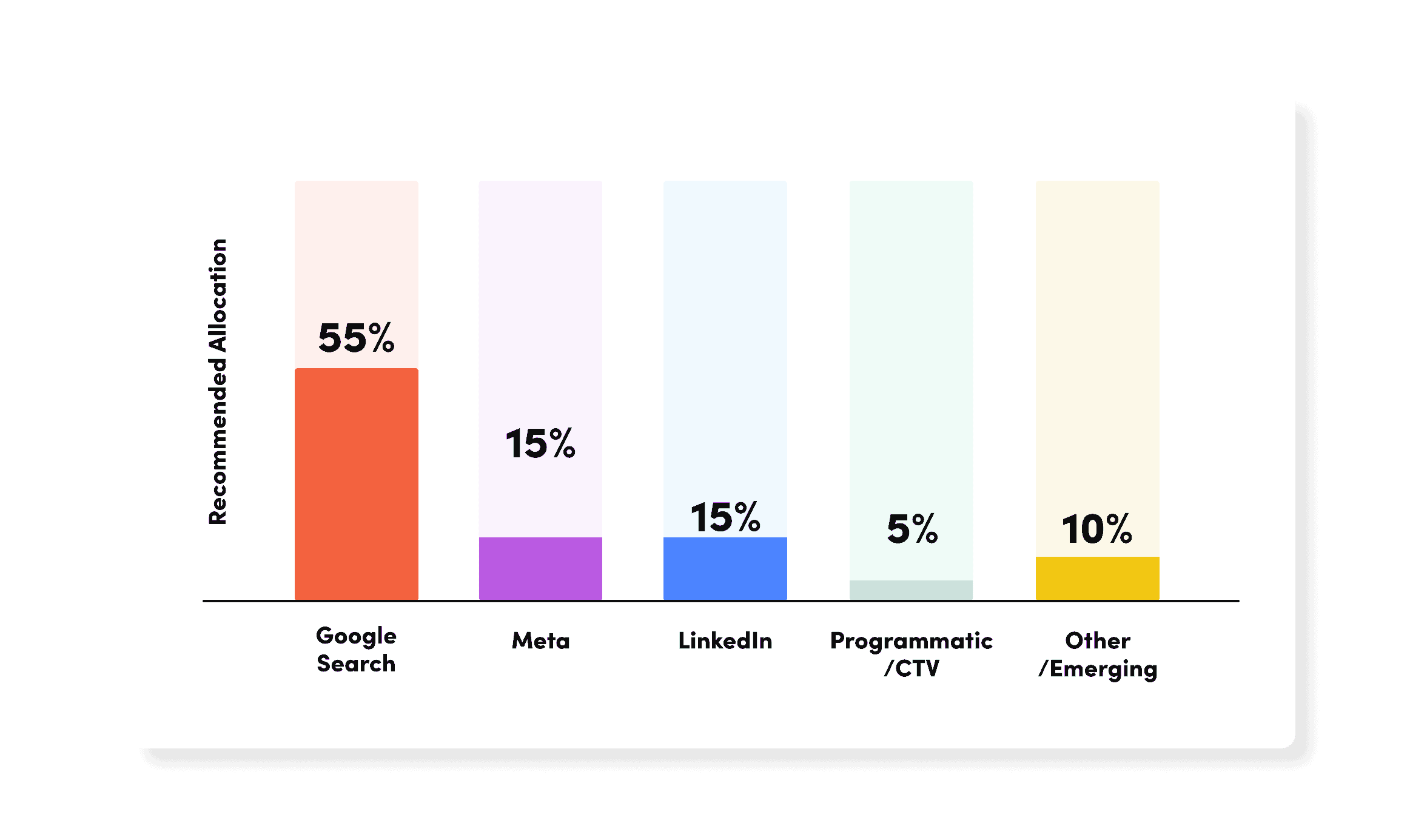
The model below corrects for that, and is built on performance-weighted logic: budget should follow demonstrated impact on enrollment outcomes, with a reserve in place for channels that offer near-term competitive opportunity.
Keep in mind that this isn’t a universal prescription. You should consider program type, market maturity, competitive intensity, and institutional goals when determining your specific spend. But for most graduate programs operating with moderate to large paid media budgets, this model provides a strong baseline.
A couple of notes on applying the following model:
- If a channel’s percentage allocation would put its monthly spend below $2,000, you likely shouldn’t run that channel at all. Thin budgets rarely generate enough volume to learn from, let alone perform.
- This framework is meant to be rolled out sequentially, not all at once. Google Search should be optimized before you layer in Meta, and Meta and LinkedIn should be established before you introduce Programmatic/CTV. Lay the foundation first, and then expand.
Platform Deep Dives
The recommended allocation percentages above are only as useful as the strategy behind them. Here’s a closer look at each platform and why they earn their share of the budget.
Google Search (55%)
For graduate programs, no channel matches Google Search when it comes to capturing prospects who are actively in research mode. Someone searching “online MPH programs” or “executive LLM for international lawyers” has passed the browsing stage and moved onto evaluating. That intent signal is valuable, and it’s why search commands the majority of our recommended budget.
Underfunding search is one of the most common (and costly) mistakes we see. When Search budgets fall below competitive thresholds, impression share drops, lead flow becomes volatile, and enrollment targets get harder to defend. Competitors who maintain stronger search presence capture more leads — and not just any leads, they capture your leads. This channel is the floor of your media plan, not a line item to trim when budgets get tight.
Effective keyword strategy starts with understanding how your prospects search, which is usually organized around program type, delivery modality, career outcome, and geography. A prospect searching “online MBA for working professionals in Boston” is giving you four signals at once. Tightly themed ad groups built around these dimensions are what separate high-performing search accounts from ones that burn budget without generating qualified inquiries.
Match types matter too. Broad match has become more powerful with AI-driven campaign optimization, but it requires careful negative keyword management to prevent wasted spend on irrelevant queries. A blended approach — broad match with strong exclusion lists, supported by exact and phrase match for your highest-value terms — gives you both reach and precision.
Graduate Enrollment Search Campaign Keyword Framework
This framework is designed to help enrollment marketers build more comprehensive and effective search campaigns for graduate degree programs.
Too often, search campaigns focus heavily on program-specific keywords (e.g., “MBA” or “Master’s in Data Analytics”) while overlooking the many ways prospective students research graduate education throughout their decision-making journey. Prospective students rarely move directly from awareness to application. Instead, they evaluate programs, compare institutions, research career outcomes, explore delivery formats, and assess admissions requirements before selecting a school.
By organizing keywords into intent-based categories, institutions can:
- Capture prospective students at multiple stages of the enrollment journey
- Identify keyword gaps within existing campaigns
- Improve campaign scalability across multiple programs
- Align messaging with student intent
- Increase qualified lead volume while maintaining efficiency
- While specific keywords will vary by institution and program portfolio, these categories provide a framework that can be applied to virtually any graduate degree program.
1. Program-Specific Queries
The prospect knows the degree or program they are interested in and is actively searching for educational options.
Examples
- MBA program
- Master’s in Data Analytics
- MSN Nursing Leadership
- Master’s in Social Work
- Doctor of Education
Intent Level
- Highest
2. Program + Attribute Queries
The prospect knows the program they want and is narrowing their options based on specific school or program attributes.
Delivery Format Examples
- Online MBA
- Hybrid MSW Program
- Part-Time MPH
- Evening MBA Classes
- Accelerated MSN Program
Admissions Requirement Examples
- MBA No GMAT
- Master’s Degree No GRE
- Direct Entry MSN
- Low GPA Master’s Programs
- Rolling Admissions MBA
Location Examples
- MBA Programs in Boston
- Online MBA in Texas
- Social Work Masters Programs Near Me
- MPH Programs in California
- MPH Programs in New England
Affordability Examples (when applicable)
- Affordable MBA Programs
- Low Cost Online Master’s Degree
- Cheapest MPH Programs
- Employer Funded Master’s Programs
- Financial Aid for Graduate School
Intent Level
- Very High
3. Best / Top Program Queries
The prospect is evaluating multiple options and looking for recommendations, rankings, or quality indicators.
Examples
- Best Online MBA Programs
- Top Master’s in Data Analytics
- Best Social Work Schools
- Top Nursing Leadership Programs
- Best MPH Programs for Working Professionals
Intent Level
- High
4. Program Comparison Queries
The prospect is deciding between programs, institutions, or learning formats.
Program vs. Program Examples
- MBA vs Master’s in Management
- MPH vs MHA
- MSW vs Counseling Degree
- MBA vs EMBA
- Data Science vs Data Analytics Master’s
School vs. School Examples
- BU MBA vs Northeastern MBA
- Duke MPH vs UNC MPH
Format vs. Format Examples
- Online MBA vs In-Person MBA
- Part-Time vs Full-Time MBA
Intent Level
- Low to Very High (degree comparisons are lower and cheaper, but specific programs compared between schools are extremely high intent).
5. Career Outcome Queries
The prospect begins with a career goal and is seeking the educational path to achieve it.
Examples
- How to Become a Healthcare Administrator
- How to Become a Data Analyst
- How to Become a School Principal
- How to Become a Licensed Counselor
- Leadership Careers in Healthcare
Intent Level
- Medium-High
6. Salary & ROI Queries
The prospect is evaluating the financial and professional value of pursuing a graduate degree.
Examples
- MBA Salary Increase
- Social Worker Salary with Master’s Degree
- Healthcare Administrator Salary
- Data Analytics Master’s ROI
- Is an MBA Worth It
Intent Level
- Medium-High
7. Credential & Advancement Queries
The prospect wants professional advancement but may not yet know which degree or credential best fits their goals.
Examples
- Graduate Degree for Teachers
- Degree to Become a Principal
- Master’s Degree for HR Professionals
- Leadership Degree for Nurses
- Best Graduate Degree for Career Advancement
Intent Level
- Medium
8. Audience-Specific Queries
The prospect is searching based on their personal situation, profession, or life stage.
Examples
- MBA for Military Veterans
- Master’s Programs for Working Professionals
- Graduate Programs for Teachers
- MBA for Engineers
- Online Master’s for Busy Parents
Intent Level
- High
9. Admissions & Application Queries
The prospect is actively preparing to apply and researching admissions requirements.
Examples
- MBA Application Requirements
- [Insert University] MPH Application Deadlines
- Personal Statement for MPH
- MBA Admissions Process
Intent Level
- Medium to High
10. Branded Program Queries
The prospect is evaluating a specific institution and is often among the most qualified search audiences.
Examples
- Boston University MBA
- Northeastern Online MBA
- Pace University MBA Tuition
- Duke MPH Admissions
Intent Level
- Highest
Executive Summary
For planning, reporting, and campaign development, these categories can be simplified into six primary keyword groups:
| Category | Example |
|---|---|
| Program-Specific | MBA, MSW, MPH |
| Program + Attribute | Online MBA, No GMAT MBA |
| Best / Top Programs | Best Online MBA |
| Comparison Queries | MBA vs MHA |
| Career Outcome Queries | How to Become a Healthcare Administrator |
| Branded Program Queries | Boston University MBA |
Together, these six categories capture the majority of graduate enrollment search behavior and provide a scalable framework that can be applied across virtually any institution, degree program, or enrollment marketing strategy.
Meta (15%)
In a graduate media plan, Meta is best suited to playing a supporting role. That’s because when you treat Meta as a primary acquisition channel for high-tuition degrees, lead quality tends to suffer and cost per acquisition is more likely to climb. The platform’s real strength is in re-engagement, reaching prospects who’ve already expressed interest and giving them compelling reasons to move forward.
Retargeting is where Meta really earns its budget. A prospect who visited your program page but didn’t inquire is a warm lead. One who clicked a search ad and bounced is even warmer. Meta lets you stay in front of those audiences with messaging that’s more nuanced than a search ad can accommodate. Creative that converts on Meta leads with outcomes, not features; is specific instead of generic; and features real stories from real people (think student testimonials, alumni outcomes, faculty profiles, and day-in-the-life content).
The content isn’t the only thing that matters. The format it’s presented in is just as important. Graduate audiences are making high-consideration decisions, and respond best to layered, specific storytelling, which is why static images tend to underperform when compared to video. Nine times out of ten, a 30-second reel featuring an alum describing how a program changed their career trajectory is more effective than a generic “apply now” banner. The more specific the story, the better it performs.
Certificate and continuing education (CE) programs are a notable exception to the “Meta as retargeting only” rule. Shorter consideration cycles, lower price points, and broader audience pools make Meta a viable primary acquisition channel for non-degree offerings. Institutions with robust CE portfolios often see strong direct-response results here that don’t translate cleanly to their graduate degree programs.
LinkedIn (5%)
LinkedIn is the most professionally contextual platform available to graduate marketers, but that advantage comes with a tradeoff: It’s also the most expensive on a CPM basis. For many programs, conversion volume is inconsistent enough that heavy investment is difficult to justify on ROI grounds alone. But written off entirely, it’s a missed opportunity — particularly for programs where professional identity is central to the value proposition.
The platform’s targeting capabilities are unique. Job title, seniority level, industry, company size, and years of experience can all be layered together in ways that Meta and Google simply can’t replicate. For an executive MBA targeting mid-career professionals in financial services, or an employer-aligned leadership degree aimed at directors and VPs, that precision is invaluable.
Where LinkedIn underperforms is in conversion volume and cost efficiency at scale. CPM regularly runs much higher than Meta, and the platform’s user base, while professionally engaged, isn’t always in an active educational decision-making mindset. That means ads need to work harder to earn attention, which puts a premium on creative that leads with career relevance and professional aspiration rather than program features.
We recommend treating the 5% allocation as a structured testing budget. It’s enough to gather meaningful data on audience response and creative performance, with defined learning goals rather than enrollment targets. While “did LinkedIn drive applications?” is an important question to ask yourself, it isn’t the one you focus on at this stage. Instead, “which audiences and messages show enough signal to justify scaling?” is a better reference point. That reframe makes the investment much easier to defend internally.
Programmatic/CTV (15%)
Programmatic display and connected TV serve a fundamentally different purpose than search or social. Holding them to the same cost-per-lead benchmarks is a mistake that can lead institutions to defund channels that are doing important work.
Their job is to build the brand familiarity and program awareness that makes everything else perform better. A prospect who has encountered your institution’s messaging before converts at higher rates when they see your search ad or Meta retargeting campaign later on. While programmatic and CTV might not close enrollments on their own, they create the conditions under which closing becomes easier down the road.
Connected TV — ads served on streaming platforms and watched on television screens — is an increasingly important channel for reaching a working adult audience. Prospects in this demographic are difficult to reach during the day, and they aren’t scrolling through social media during prime times. That said, they are watching streaming content in the evening, and a well-produced 30- or 60-second CTV spot running in front of professionally relevant content can do significant brand-building work at a fraction of what traditional media would cost.
Programmatic display rounds out the mix with targeting precision — contextual alignment with industry publications, alumni news sites, and professional content — and retargeting capabilities that extend your reach beyond Meta’s ecosystem. For new program launches, geographic expansion, or competitive repositioning, this channel is often what separates institutions that break through in a new market from those that never quite gain traction.
Emerging Channel Testing (10%)
Higher ed marketing budgets tend to concentrate heavily on proven channels, which means emerging platforms are often underpowered or ignored entirely. A dedicated 10% testing budget creates room to experiment before a channel becomes crowded, without putting core performance at risk.
To give yourself a head start, these platforms are worth experimenting with:
- Reddit Ads: Subreddits such as r/gradadmissions, r/MBA, and program-specific communities are full of exactly the kind of intellectually curious, actively evaluating prospects that graduate programs want. Contextual targeting within these communities places your message in front of people who are the most likely to already be in the decision-making mindset.
- ChatGPT and Perplexity Ads: A growing share of graduate prospects now begin their program research with AI-assisted queries rather than traditional search. Being one of the first to establish presence in those discovery flows is an advantageous early-mover opportunity.
- Spotify Audio: Pursuing this avenue gets you access to working professionals during commute time, workout sessions, and other moments when they’re receptive to brand messaging but unreachable through visual channels.
- YouTube Shorts and Reels: If you’re looking to deliver high-reach, quick-hit awareness at relatively low CPM, this is a great option. Short-form video is particularly effective for CE and certificate programs where the goal is broad top-of-funnel visibility rather than deep funnel engagement.
The key to presenting test results to skeptical leadership is framing them correctly from the start. These are learning investments with defined hypotheses and success metrics, not performance channels held to the same cost per lead standards as search. Establish that framing before a campaign launches, document what you learn, and the conversation about whether to scale becomes much more straightforward.
Benchmark Costs by Program Type
Before you can build a defensible budget, you need a realistic picture of what student acquisition actually costs across the full enrollment funnel. Three metrics form the foundation of that picture:
- Cost per inquiry (CPI): What you pay to generate a single prospective student contact
- Cost per application (CPA): Measures what it costs to move a prospect all the way to a submitted application
- Cost per enrolled student (CPS): The total paid media investment required to convert one prospect into a paying student
Together, these numbers tell a more complete story than any metric alone. For example, a low CPI means nothing if your applicant-to-enrollee conversion rate is poor. And a high CPS is much easier to justify when it’s set against a program’s tuition revenue and lifetime student value.
Why the Numbers Vary
These benchmarks shift based on a combination of factors that every budget plan needs to account for.
Program type is the most significant driver. Doctoral and law programs, for instance, attract smaller, highly specialized audiences, which means longer search cycles, more competitive keywords, and higher costs at every funnel stage. By contrast, certificate and continuing ed programs have broader audiences, shorter consideration cycles, and lower tuition barriers, all of which compress costs considerably.
Modality and geography also play a meaningful role. Online programs can reach national audiences, which increases competition but also expands the prospective student pool. Programs with regional or campus-based requirements face tighter geographic constraints that can drive CPI up in densely competitive metro markets.
Brand awareness is a variable that often gets overlooked in budget planning. Institutions with strong name recognition benefit from high organic search visibility, which creates a halo effect that lowers paid media costs across the board. Prospects already familiar with your institution convert at higher rates and lower cost than those encountering your brand for the first time through a paid ad.
Finally, retargeting infrastructure has a similar compounding effect. Programs that have invested in building warm audience pools are more likely to outperform programs spending the same budget with none of that foundation in place.
Recommended Monthly Budget Ranges
Creating a monthly budget requires layering in your enrollment goals, your program’s competitive context, and where you are in the program lifecycle.
We think about monthly budgets across three tiers:
- Conservative represents the minimum viable investment to generate meaningful lead volume and maintain competitive presence. A conservative budget isn’t ideal for growth, but is sufficient to sustain an existing program with established brand awareness and a healthy pipeline.
- Moderate is the steady-state budget for a program operating in a competitive market with active enrollment goals. It allows for full-funnel coverage, retargeting, and enough volume to optimize campaign performance over time.
- Aggressive is appropriate for program launches, market expansion, competitive repositioning, or situations where enrollment targets require a significant increase in lead volume within a defined timeframe.
A Note on Seasonality
Graduate enrollment follows predictable inquiry and application cycles, and paid media budgets should flex accordingly rather than running at flat monthly rates year-round.
For many graduate programs, inquiry volume peaks in fall (September through November) and again in late winter (January through March), aligned with application deadlines. If your data reflects these patterns, these are the windows where aggressive spend tends to pay the highest dividends since prospects are in decision mode and competition for their attention is highest.
Conversely, for the periods that show softer inquiry volume, consider redirecting a portion of your budget toward brand awareness channels, such as programmatic, CTV, or content amplification. The goal in these times is to keep your institution visible without competing at full cost in a lower-intent environment.
Overall, the most common seasonality mistake we see is running flat budgets year-round and then scrambling to increase spend reactively when enrollment targets look shaky. If you have even one or two cycles of inquiry data to work from, use it to build seasonal surges into your annual plan from the start.
What Not to Do: The 6 Most Common Budget-Planning Pitfalls
A well-allocated budget is key, but how you manage, protect, and execute against it determines whether the numbers you put on paper translate into enrolled students. Avoiding the mistakes below can mean the difference between hitting enrollment targets and having to explain why you didn’t.
1. No Early-Stage Offer or Lead Nurture
Driving traffic to a program page with no conversion offer beyond “Request Information” is one of the most common ways graduate marketing budgets get wasted. For a prospect who is six to 12 months away from making a decision, a generic inquiry form is rarely compelling enough to capture their contact information.
Top-of-funnel value looks different for graduate prospects than it does for undergrad or consumer audiences. This is a sophisticated, outcome-oriented audience. What earns their contact info is content that respects their intelligence and speaks directly to their decision: salary outcome reports, career trajectory guides, program comparison tools, application prep webinars, or honest “is this program right for you?” assessments. The more specific the offer is to the program and audience, the better it performs.
The underlying principle is simple — give prospects a reason to stay in your ecosystem before they’re ready to commit. Graduate consideration cycles routinely run up to 18 months. Marketers who only try to capture inquiries while doing nothing to engage prospects earlier in that window leave out a sizable portion of their addressable audience. A well-designed nurture sequence, triggered by an early-stage content download, can maintain a relationship with a prospect across that entire timeframe at a fraction of the cost of re-aquiring them through paid media later.
2. Overweighting a Single Channel
It’s tempting to double down on what’s working. If search is driving strong lead volume, the instinct is to feed it more budget. If Meta had a good semester, it’s easy to let it absorb a larger share of the plan. The problem is that single-channel dependency creates a fragility that isn’t visible until something goes wrong.
Platform algorithms change, auction prices spike, or a policy update restricts your targeting options. A competitor enters your market and drives up CPMs almost overnight. When any of these happen to a channel carrying a majority of your budget, the result is a drop in lead volume that your pipeline wasn’t built to absorb. By the time you’ve reallocated budget and rebuilt momentum on a different channel, you’ve lost weeks of lead flow that can’t be recovered within a recruitment cycle.
A diversified channel mix doesn’t mean spreading the budget so thin that nothing performs. Instead, it means giving each platform a defined role and enough budget to fulfill it so that if one channel underperforms, the others can sustain momentum while you course correct.
3. Underfunding Brand Awareness
Most graduate marketing budgets are built around demand capture (e.g., search, retargeting, conversion-focused campaigns). That makes sense up to a point. But institutions that allocate everything to lower-funnel tactics and nothing to awareness essentially harvest demand they didn’t create, and that approach has a ceiling.
The brand-to-demand ratio problem in higher ed is well-documented: Institutions consistently underinvest in upper-funnel awareness relative to the length and complexity of the graduate decision cycle. A prospect considering a graduate degree may spend between six and 18 months researching before they ever fill out an inquiry form. If your institution isn’t present during that research phase — whether through programmatic, CTV, content, or organic visibility — you may never appear in their consideration set at all, regardless of how well your search campaigns perform.
This carries the biggest consequences for new programs and lower-cost offerings. New programs don’t have alumni networks, word-of-mouth, or years of search visibility working in their favor. They need paid awareness investment to build the familiarity that established programs take for granted. Lower-cost programs, meanwhile, often receive the smallest marketing budgets even though their audience pools are broader and awareness spend tends to be highly efficient at scale.
The attribution challenge is real: awareness spend rarely gets credit in last-click models, which makes it easy to cut when budgets tighten. But the downstream impact is consistent. Prospects who’ve encountered your brand before convert at higher rates and lower cost when they reach your lower-funnel campaigns.
4. No Retargeting Strategy
The majority of prospects who engage with your paid media for the first time won’t convert on that first touch. They’ll click an ad, spend time on your program page, and leave without inquiring. But it isn’t always because they aren’t interested, they likely just aren’t ready. Without a retargeting strategy, the relationship ends before it even has a chance to start. With one, it’s where the real work begins.
A basic retargeting strategy involves segmenting website visitors by behavior (think program page visitors, application starters, repeat visitors) and serving each segment messaging that speaks to where they are in the decision process. For example, someone who visited your program page once gets brand reinforcement while someone else who started an application and abandoned it gets a direct, friction-reducing message.
Meta and programmatic are the primary vehicles for this work, and they function best in tandem with search rather than in isolation. A prospect might first encounter your program through a search ad, visit your site, leave, see a Meta retargeting ad three days later, and convert on a second search click a week after that. Last-click attribution will credit search for the conversion. In reality, all three touchpoints contributed, which is why you shouldn’t put your retargeting budget on the back burner.
5. Ignoring Lead-to-Enrollment Lag Times
Graduate enrollment operates on timelines that most paid media reporting frameworks weren’t built to accommodate. When leadership looks at a campaign’s 30-day performance and asks why it isn’t generating enrollments, the honest answer is often “because those enrollments won’t happen for another eight months.”
The attribution trap is real, and it’s expensive. Last-click, short-window attribution models systematically undervalue the channels and campaigns that do early-funnel work, such as generating awareness, consideration, and early lead capture, because their contribution to enrollment shows up too late to register in standard reporting. The result is a predictable pattern where upper funnel investment gets cut because it “isn’t performing,” deteriorating lead quality and softened enrollment numbers a cycle or two later.
Building budget models that account for long conversion windows requires shifting from campaign-level reporting to cohort-based tracking. Rather than asking “what did this campaign generate this month,” the more useful question is “what is the enrolled value of the inquiry cohort we generated six months ago?” That framing connects media spend to enrollment outcomes in a way that reflects how graduate decisions actually happen. Plus, it gives you a much more defensible story to tell leadership when they inevitably ask about ROI.
6. Running Generic Ads
Budget allocation, channel mix, and bidding strategy matter enormously, but they operate within a ceiling set by creative quality. The most efficiently allocated budget in the world will underperform if the ads it’s funding don’t give prospects a compelling reason to stop scrolling.
Stock photography, vague value propositions, and institution-first messaging are all examples of generic creative, which carries a measurable cost-per-conversion premium. While it might be reaching the right audiences, it fails to perform as well as specific, outcome-oriented creative because it fails to say anything meaningful when it gets there. “Advance your career with our flexible online MBA” is a sentence that every MBA program in the country could run. It doesn’t stand out, and worse, it gives a prospective student no reason to choose you.
What performs instead is specificity. Real student and alumni stories, told in their own words, consistently outperform polished institutional messaging. Outcome-specific proof points — “85% of our MPH graduates report a promotion within two years” — outperform generic claims about program quality. And creative that speaks directly to the identity and ambitions of a specific prospect type outperforms creative designed to appeal to everyone.
The good news is that the gap between generic and specific creative is often easier to close than marketers expect. Swapping a stock image for an authentic alumni photo, replacing a generic headline with a program-specific outcome stat, or running a short testimonial video in place of a feature-list carousel are all high-impact changes that don’t require a full creative overhaul.
Building a paid media budget that earns leadership buy-in, drives real enrollment outcomes, and holds up under scrutiny isn’t something you have to figure out alone. As a full-service digital marketing agency with 20+ years of experience and expertise in graduate and continuing education marketing, Vital knows what works across program types, budget sizes, and competitive markets.
If you’re ready to pressure-test your current strategy or start a smarter one, let’s talk.