We’ve been running AI visibility audits on university websites, and the pattern is consistent: Most institutions aren’t ready for the shift.
Take a regional public university we audited recently — strong brand narrative, growing enrollment, a genuinely compelling affordability story. By every traditional measure, a school worth recommending. But across large language models (LLMs), its visibility was largely passive. It was being mentioned but not recommended.
There’s a big difference.
The good news is the gap between where most university websites are and where they need to be is closeable. Here’s where to start.
Key Takeaways
- AI crawlers can be blocked without you knowing it. Check your robots.txt file before anything else.
- Structure is everything. LLMs can’t synthesize a wall of text. Break content into sections, headings, and Q&A formats they can actually extract from.
- Freshness is a citation signal. If your content hasn’t been updated recently, it’s less likely to show up in AI-generated answers.
- Front-load what matters. Nearly half of all ChatGPT citations come from the top third of a page. If your best content is buried, it’s not working hard enough.
- Your offsite presence matters as much as your website. Rankings, directories, news coverage, and YouTube activity all feed the models that determine whether you get cited.
- “Mentioned” and “recommended” aren’t the same thing. Audit what LLMs actually say about your institution, and then close the gap.
- You can’t manage what you’re not measuring. Set up LLM referral tracking now, before AI traffic grows any further.
Why AI Search Is Different from Traditional SEO
Traditional SEO was a game of position. You optimized for keywords, earned backlinks, and fought for the top spot on a results page. The goal was visibility — to get your link in front of someone who’d decide whether to click.
AI search is a game of answers. There’s no page of results to scan. There’s one response that your institution is either represented in or not.
It shifts the entire framework:
- Keywords → Prompts. Students aren’t searching “nursing program Ohio.” They’re asking, “What’s the best nursing program in Ohio for someone who wants to work in pediatrics?” Your content needs to answer questions, not just contain keywords.
- Rankings → Share of voice. The metric that matters now is whether your institution shows up in AI-generated responses about your programs, outcomes, and differentiators across all the major LLMs.
- Best position → Best answer. LLMs cite the content that’s most useful, most credible, and most clearly structured, not the content with the highest domain authority from 2019.
AI Search Optimization for Universities: Top 12 Variables
Universities are actually well-positioned to win when it comes to AI optimization. You have expertise, outcomes data, and institutional credibility that AI tools are specifically designed to prioritize. You just need to make sure your website is set up to communicate that clearly. Here are the 12 variables that determine whether it is.
1. AI Bot Accessibility
What it is: A check to make sure your website isn’t accidentally turning away AI crawlers before they can read your content.
Why LLMs prioritize it: If GPTBot, ClaudeBot, PerplexityBot, and other AI crawlers can’t read your content, they can’t cite it. This is the most foundational variable on this list — everything else is moot if bots are blocked at the door.
Action step: Pull up your robots.txt file (yourdomain.edu/robots.txt) and check for any disallow rules that would affect AI crawlers. Common culprits include blanket wildcard blocks (User-agent: *) or specific bot exclusions added during a security review that nobody revisited. If you’re intentionally blocking certain crawlers for specific sections of your site, that’s fine — just make sure it’s intentional, not accidental.
2. Technical Site Health
What it is: The baseline technical performance of your site, including speed, crawlability, and indexing integrity.
Why LLMs prioritize it: AI systems are trained on content that search engines have already indexed. If your pages are slow to load, blocked from crawling, or returning errors, they’re less likely to be indexed — and therefore less likely to be part of the training data or live retrieval that feeds LLM responses.
Action step: Run a full technical audit using a tool such as Screaming Frog or Semrush. Prioritize fixing crawl errors and redirect chains, resolving any accidental noindex tags on high-value pages, and improving Core Web Vitals scores on your most-visited pages (e.g., admissions, programs, outcomes).
3. Modular Content Structure
What it is: The way your page content is organized — whether it’s broken into clear, discrete sections with headings, summaries, numbered steps, and tables.
Why LLMs prioritize it: LLMs extract meaning based on structure. A page with one long block of text is hard to synthesize. A page with a clear H2 summary and bulleted key points gives an LLM exactly what it needs to pull a clean, accurate answer.
Action step: Audit your highest-traffic pages for structure. Each page should have a clear H1 that names exactly what the page is, H2s that break content into logical sections, and at least one structured element — a table, a numbered list, a summary box — that an LLM can lift and use directly. If a page reads like a brochure, rewrite it to read like a resource.
4. FAQ Usage
What it is: The presence of explicit question-and-answer formatted content on your pages.
Why LLMs prioritize it: AI search is quite literally a question-answering machine. When a student asks, “Does [University] offer an accelerated nursing program?” — an LLM is going to look for a page that directly answers that question. If your nursing program page has an FAQ section that says “Do you offer an accelerated option? Yes, our 16-month accelerated BSN…” — you’re in great shape. If it doesn’t, you’re leaving that answer on the table.
Action step: Add FAQ sections to every high-intent page: program pages, admissions pages, tuition and financial aid pages. Write the questions in the conversational, specific way students actually ask them.
5. Content Freshness
What it is: How recently your content has been updated.
Why LLMs prioritize it: LLMs are trained to surface timely, accurate information, and stale content is a credibility signal in the wrong direction. Research shows 79% of pages cited by ChatGPT were updated in 2025, and 76% of top-cited pages were refreshed within the last 30 days.
Action step: Conduct a content freshness audit of your top pages by traffic. For any page that hasn’t been meaningfully updated in the past year, schedule a refresh. This means new information, updated data, or revised copy — not just changing the “last reviewed” date. Start with program pages, tuition information, outcomes data, and admissions deadlines.
6. Top-of-Page Content Optimization
What it is: The strategic placement of your most important information at the top of each page.
Why LLMs prioritize it: Research shows that 44.2% of ChatGPT citations pull from the top third of a page’s content. LLMs read like a smart, impatient researcher: They’re looking for the answer fast, and they’re going to weigh what they find first. If your program page opens with a scenic photo and a tagline about “transforming futures,” you’ve already lost the lead.
Action step: For every high-priority page, apply the “top third test.” Read only the first third of the page and ask whether someone — or something — could extract a clear, accurate summary of what this page is about, who it’s for, and what the key facts are. If the answer is no, you’ll benefit from a restructure that puts the most citable content first.
7. Authoritative Source Citations
What it is: The practice of supporting your claims with links to credible external sources.
Why LLMs prioritize it: LLMs are trained to identify and prioritize content that demonstrates credibility and shows its work. For example, when you cite a salary projection by the U.S. Bureau of Labor Statistics, you’re telling the model: This content is grounded in verifiable information, not marketing copy.
Action step: Audit your program and outcomes pages for unsupported claims. Statements such as “graduates go on to high-paying careers” should be replaced with “according to the Bureau of Labor Statistics, [field] professionals earn a median salary of $X.” Link out to the source. Those links signal confidence in your content.
8. Schema Markup and Structured Data
What it is: Behind-the-scenes code that tells search engines and AI systems exactly what your content is and how to categorize it.
Why LLMs prioritize it: Schema markup gives LLMs an explicit map of your content — this is an article, this is an FAQ, this is an educational organization, this is a course. Without it, they’re inferring structure. With it, they have a blueprint, which makes your content easier to cite accurately.
Action step: Implement schema markup across your highest-value pages. Priority types for universities include Educational Organization, Course, FAQ Page, Article, and BreadcrumbList. Use Google’s Rich Results Test to validate your implementation. If your CMS doesn’t support schema natively, your development team can add it via a plugin or custom code.
9. Offsite Mentions and Brand Authority
What it is: The presence of your institution in third-party content — rankings pages, listicles, directory listings, news coverage, and external backlinks.
Why LLMs prioritize it: In addition to reading your website, LLMs are reading everything that mentions you. When an LLM encounters your institution mentioned in a U.S. News ranking, a “best colleges for nursing” listicle, a Wikipedia entry, or a regional news story, that corroborates your authority. The more your name appears in credible, third-party contexts, the more confident the model is in citing you.
Action step: Audit where your institution currently appears in third-party content. Ensure that your profiles on major rankings sites and directories are complete and accurate, pitch guest content and earned media placements, and pursue link-building from regional news outlets and industry publications.
10. Brand Sentiment Among LLMs
What it is: What AI tools actually say about your institution when someone asks.
Why it matters: This is the variable most universities haven’t thought to audit — and it might be the most revealing one on the list. When a prospective student asks ChatGPT, “What’s [University] known for?” or “Is [University] a good school for business?” — you need to know what comes back.
Action step: Sit down and run your school through the major LLMs — ChatGPT, Claude, Gemini, and Perplexity. Ask the questions your prospective students are asking and document the responses. Look for: accuracy (is the information current?), completeness (are the right programs represented?), and sentiment (is the framing positive, neutral, or concerning?). Trace the gaps back to their source — missing content, outdated information, thin offsite presence — and address them at the root.
11. YouTube Publishing Strategy
What it is: Your institution’s presence and activity on YouTube.
Why LLMs prioritize it: This one might surprise you: YouTube mentions are the single strongest predictor of AI visibility. YouTube is the second-largest search engine in the world, its content is heavily indexed, and LLMs are trained on its transcripts, descriptions, and metadata at scale. An institution with an active, well-optimized YouTube channel is increasing its footprint across every AI system that learns from YouTube content.
Action step: Audit your YouTube channel. Are you publishing consistently? Are your video titles, descriptions, and tags optimized with the language prospective students actually use? Do your videos include transcripts or closed captions (which are indexed as text)? If your channel is lacking, a strategic relaunch focused on student stories, program overviews, and outcomes spotlights is one of the highest-leverage AI visibility investments you can make.
12. LLM Referral Traffic Tracking
What it is: The measurement of direct referral traffic arriving at your site from AI tools such as ChatGPT, Perplexity, Claude, and Gemini.
Why it matters: You can’t optimize what you’re not measuring. LLM referral traffic is already showing up in analytics for institutions with strong AI visibility. Most universities don’t have tracking in place to see it, which means they’re flying blind on one of the fastest-growing traffic sources in higher ed.
Action step: Set up referral tracking in your analytics platform for known LLM domains. In GA4, create a segment or channel grouping that captures traffic from sources including chat.openai.com, perplexity.ai, claude.ai, gemini.google.com, and copilot.microsoft.com. Establish a baseline now, so you have a benchmark to measure against as AI search continues to grow.
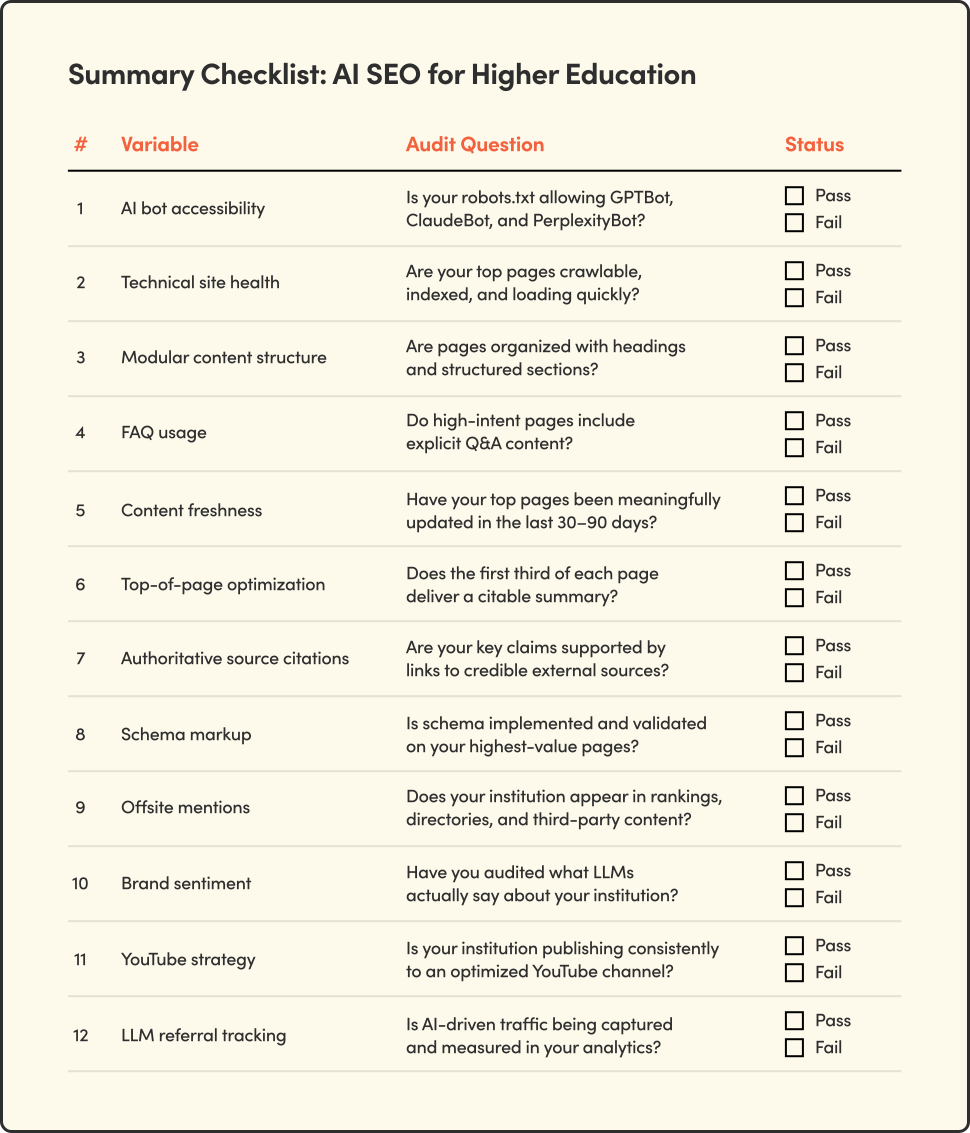
Summary Checklist: AI SEO for Higher Education
What to Do Next: Building an AI Visibility Strategy
If you just worked through the checklist, you have a clearer picture of where you stand. Now let’s talk about the best approach to implementing changes.
Fix the foundation first. AI bot accessibility and technical site health are prerequisites for everything else. If crawlers can’t reach your content, none of the other work matters. Tackle these before anything else.
Go after the quick wins. Modular content structure, FAQ usage, and top-of-page optimization are high-impact and largely within your control. These are content decisions, which means your team can make meaningful progress quickly.
Refresh what you’ve got. Content freshness doesn’t require a full rewrite strategy. Pick your highest-traffic pages, update the data, sharpen the copy, and add structured Q&A sections where they’re missing. Do it now and then again in 90 days.
Invest in the long game. Offsite mentions, YouTube publishing, and brand sentiment are slower to build, but they’re the variables that compound. An institution that starts showing up consistently in third-party content and AI-generated responses today is building an advantage that’s hard to replicate a year from now.
Measure from day one. Set up LLM referral tracking to establish a baseline. You’ll be able to demonstrate the impact of everything you implement going forward.
FAQs
Q: What’s the difference between traditional SEO and AI SEO?
A: Traditional SEO is about ranking — getting your page to the top of a results list so someone clicks your link. AI SEO is about being the answer when a student asks ChatGPT or Perplexity, for example, about nursing programs in your state. When there’s no list of links to choose from, either your institution is represented in the response or it isn’t. The strategies that get you there overlap with traditional SEO in some ways, but the content structure, freshness requirements, and offsite signals that drive AI visibility are a different game entirely.
Q: How do I know if AI crawlers are blocked on our site?
A: To know if AI crawlers are blocked on your site, type your domain into a browser followed by /robots.txt — for example, youruniversity.edu/robots.txt. You’ll see a plain text file listing which bots are allowed or blocked. Look for any rules referencing GPTBot, ClaudeBot, or PerplexityBot, or blanket wildcard blocks that could be keeping all bots out.
Q: How often should website content be updated for AI search?
A: Research shows that 76% of pages cited by AI tools were refreshed within the last 30 days. That doesn’t mean rewriting everything every month — it means keeping your highest-traffic, highest-intent pages current. Program details, tuition information, outcomes data, and admissions deadlines should be reviewed at minimum every semester. Set a recurring content audit on your calendar and treat it like any other marketing priority.
Q: Do we need a developer to make these changes?
A: Some variables — like fixing robots.txt, implementing schema markup, or improving site speed — will require your web team or a development partner. But several of the highest-impact changes are squarely in a content team’s wheelhouse: restructuring pages with clear headings, adding FAQ sections, updating stale copy, and citing credible sources. You can make meaningful progress without a full technical overhaul.
Q: What does an AI visibility audit actually involve?
A: A strong AI visibility audit evaluates your site across the variables that determine how — and whether — LLMs find, read, and cite your content. That includes a technical crawl, a review of your content structure and freshness, an analysis of your offsite presence, and a direct assessment of what major AI tools currently say about your institution. Vital’s AI visibility audit is built specifically for higher ed.
Ready to See Where Your Institution Stands?
AI search is here, and the universities that treat it as an optimization opportunity are the ones that will own the conversation when the next class of prospective students starts asking questions.
Our AI visibility audit gives you a complete picture of how your site performs across all 12 variables and a clear roadmap for how to improve.