If you’re marketing a graduate law program, you already know: Prospective students are weighing your school against peer institutions and against alternatives such as bootcamps, certificates, or continuing in their current job without pursuing further education. And they’re doing it with unprecedented scrutiny.
Today’s applicants are ROI-driven, career-focused, and digitally native. They’re asking harder questions about cost, value, and outcomes, and they expect clear answers upfront.
According to NALP’s 2025 report, employment rates for new law school grads are at record highs, but hiring remains concentrated among top firms and top schools. Likewise, U.S. News & World Report’s ranking of law schools with the most “Big Law” placements shows that large firm and clerkship roles are still disproportionately clustered among the T14 (the 14 law schools consistently ranked strongest for a Juris Doctorate, or JD). That makes differentiation critical, especially for programs outside those top tiers.
The landing page is often your first and only chance to make a compelling case. If it’s vague, clunky, or hides key details behind links and PDFs, your best-fit students will bounce before they ever inquire.
To understand what’s working (and what’s not), we reviewed the paid ad landing pages for 48 U.S. law schools, including top-tier institutions, regional players, and online programs.
Our goal? Identify how law schools are positioning themselves, what information they surface, and which conversion strategies they’re using (or skipping) altogether.
What we found: Some schools are nailing the basics — strong CTAs, clean layouts, and mobile-friendly formats — but far too many are missing the components that matter most.
Before you dig into the data, download the full dataset so you can follow along.
Law School Landing Page Highlights
Want the TL;DR version? Here’s a snapshot of what we found across 48 paid search landing pages for JD programs:
- 75% of pages remove global navigation — a smart move for minimizing exit points.
- Only 15% offer in-page or anchor navigation, leaving mobile users to scroll without structure.
- 92% include a form on the page, and 90% of those are request-for-information (RFI) forms. The average form has 7.4 fields, and 29% use multi-step forms.
- 69% include CTAs, but placement and prominence vary widely.
- Just 44% of pages mention program duration — a key decision factor left off more than half the time.
- Only 15% show tuition. 19% mention financial aid, and 27% reference scholarships.
- Only 6% clearly present credit transfer options.
- 48% feature student testimonials. 27% use other forms of social proof, such as class size or employment rates.
- 42% highlight rankings, awards, or credentials — credibility law schools are still missing on most pages.
- 19% use video — an underutilized tool given its proven ability to build trust and engagement.
1. Scroll fatigue is real, especially without internal navigation.
Three-fourths (75%) of law school landing pages in our study remove global navigation, a best practice that helps minimize exit points and keep visitors focused on the call to action.
But once students start scrolling, the experience begins to break down. Only 15% of pages offer in-page navigation or anchor links — a major miss, especially on mobile, where long, uninterrupted pages can quickly become frustrating.
Most prospects aren’t reading every word. They’re skimming for specific information, such as program length, cost, and career outcomes. Without clear headers, a sticky nav, or quick-jump links, they’re more likely to miss what matters or abandon the page entirely.
What to do instead:
- Build structure in.
Use clear section headers, such as “Curriculum,” “Cost,” and “Career Outcomes,” to guide skimmers and help them find what they’re looking for faster. - Support scanning.
Consider sticky navigation, jump links, or other subtle wayfinding tools, especially for long-form or mobile-heavy pages. - Design for decision-stage visitors.
Your page should quickly answer three questions:
Is this program for me?
Can I afford it?
What happens next?
If it doesn’t, your best-fit students may never convert.
2. Too long, too generic: RFI forms are missing the mark
Nearly every law school landing page in our study included a form (92%), and 90% of those were standard request-for-information (RFI) forms. That’s a strong start. Forms are a key conversion point. But too often, the design gets in the way of performance.
The average form had 7.4 fields. Nearly a third (29%) used multi-step formats. While that can improve usability when done well, most didn’t use the extra space to segment audiences or tailor messaging. The fields were usually generic: first name, last name, email, phone number, and program of interest. Few forms reflected any attempt to capture intent, urgency, or background.
That’s a missed opportunity. A good form should reflect what the school wants to learn and what the user expects to get. If the pitch is “request more information,” the response should feel specific, not just another drip campaign. When a prospect gives you something valuable — their contact details — they expect something equally valuable in return.
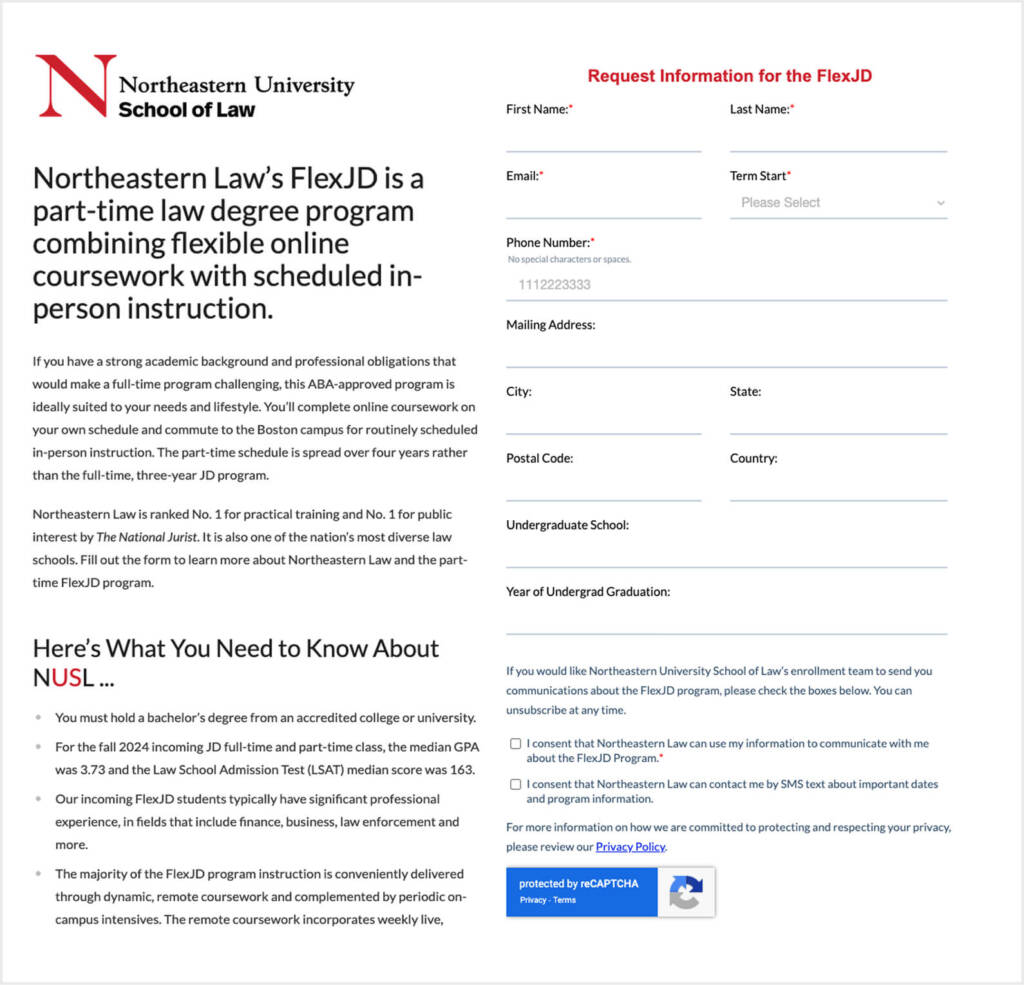
What’s wrong with this form?
Northeastern’s FlexJD landing page includes a prominent RFI form, but it asks for too much, too soon. With 12+ required fields (including full mailing address and undergrad details), the form feels more like an application than a request for info. This creates unnecessary friction, especially for early-stage prospects who aren’t ready to commit.
Tip: Keep forms short, smart, and purposeful. Use multi-step formats to segment users or personalize follow-up, not just to break up the scroll. If you’re asking for details, make sure what comes next feels like it was worth it.
3. Calls to action are often an afterthought
Nearly 70% of the law school landing pages we reviewed included at least one CTA on the page. But just having a button isn’t enough, especially when the language and placement don’t inspire action.
We found that many CTAs used vague or low-impact language such as “Learn More” or “Request Information.” These generic phrases don’t communicate what the user will get or gain, which makes them easy to ignore. By contrast, a few schools used more benefit-forward phrasing, such as “Download the Brochure” or “Start Your Application,” which makes the value of the click immediately clear.
University of Miami: 1 Phrase. 3 Buttons. Not enough direction.

Every button on this landing page uses the same vague language: “Learn More.”
Without context, it’s unclear what the user will receive — a brochure? An application? A phone call?
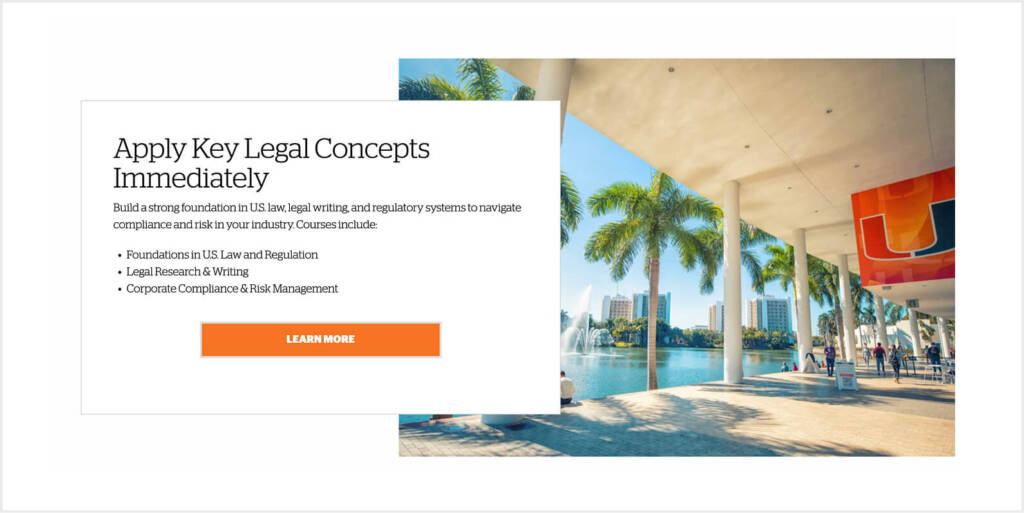
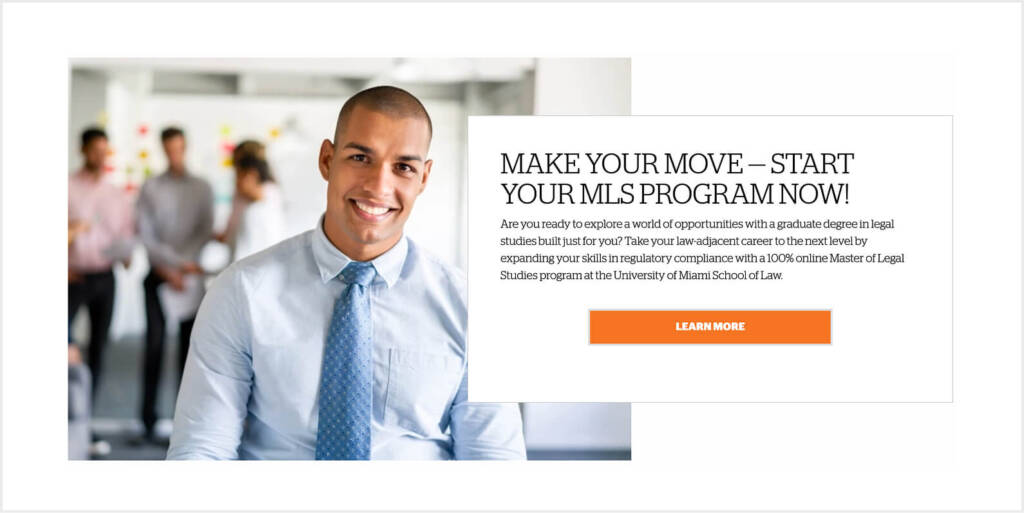
Stronger, more specific CTAs could better guide prospective students and improve conversion.
We also saw inconsistency in CTA prioritization. Some pages placed multiple buttons — “Follow Us on LinkedIn,” “Attend a Webinar,” “Apply Now,” “Request Information” — without any visual or structural hierarchy. When every CTA carries equal weight, users may not know where to start.
Form structure also played a role. In several examples, users had to scroll past long sections of program details before they even saw a form or button. And when forms were included, they sometimes appeared abruptly without helpful context or framing.
Takeaway: Be intentional with your CTAs. Use specific, benefit-driven language and make sure the next step is clear, visible, and prioritized.
4. Buried Benefits = Missed Conversions
Every school we reviewed included program benefits on its landing page, but in many cases, they weren’t easy to find or digest.
Only 36% of pages placed benefits near the top of the page, where they could immediately catch the user’s attention. More often, they were scattered mid-scroll or buried in dense paragraphs under headers such as “Why Choose Us” or “What You’ll Learn.” In some cases, these details only appeared after multiple scrolls, long after a visitor may have decided to bounce.
A few pages did highlight benefits with a strong visual hierarchy. For example, Purdue Global led with a clear, concise list of time commitment, cost per credit, and credit hours, all in a scannable format. Fordham emphasized credibility and speed upfront: “Top 40 Law School” and “Graduate in as few as 12 months.” These are the kinds of high-impact messages that speak directly to a prospective student’s mindset: Is this worth it? How fast can I finish? Will this help my career?
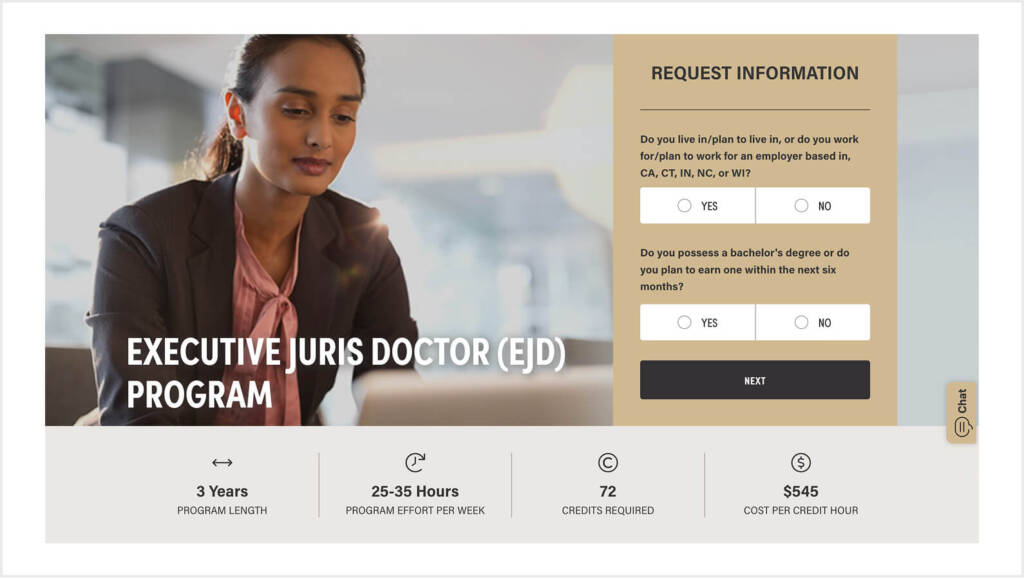
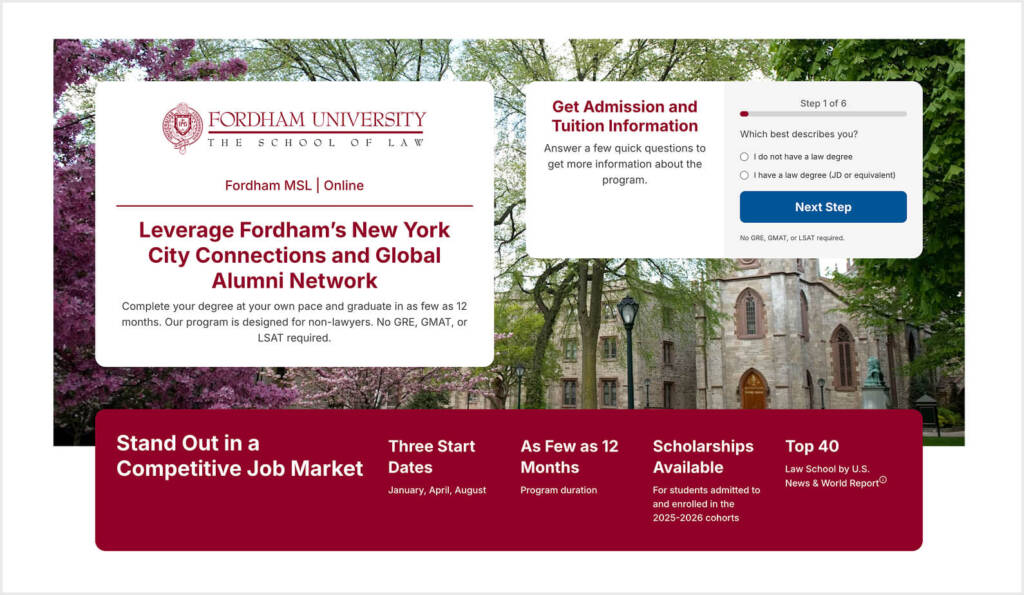
But, across the board, benefits often felt generic. Phrases such as “advance your career,” “flexible format,” or “supportive faculty” were used without specificity, making it harder for students to differentiate one program from another.
Tip: Bring your program’s strongest value props to the top of the page, and make them clear, scannable, and specific. That’s how you keep users engaged and get your offering to stand out.
5. Student voices are powerful. Most pages mute them.
According to our analysis, 48% of law school landing pages included student testimonials, which means more than half didn’t use this form of social proof at all. That’s a missed opportunity, especially given how much weight prospects place on peer validation during the decision process. And among the schools that did include testimonials, the execution often lacked clarity, strategy, or specificity.
Many testimonials appeared mid-scroll in generic sections with vague headlines such as “Student Experience.” Some were long, unformatted text blocks with no name, photo, or graduation year. Others were pushed to the bottom of the page, where they were unlikely to influence a decision.
A few schools handled it well. Regent Law, for example, paired its testimonials with headshots and titles, making them feel more personal and credible. The quotes were short and scannable, which helped reinforce key messaging, though their placement at the very bottom of the page reduced their overall impact. While they may still provide value to visitors who scroll the full length, earlier placement (especially near calls to action or program differentiators) would make them more likely to influence decision-making.
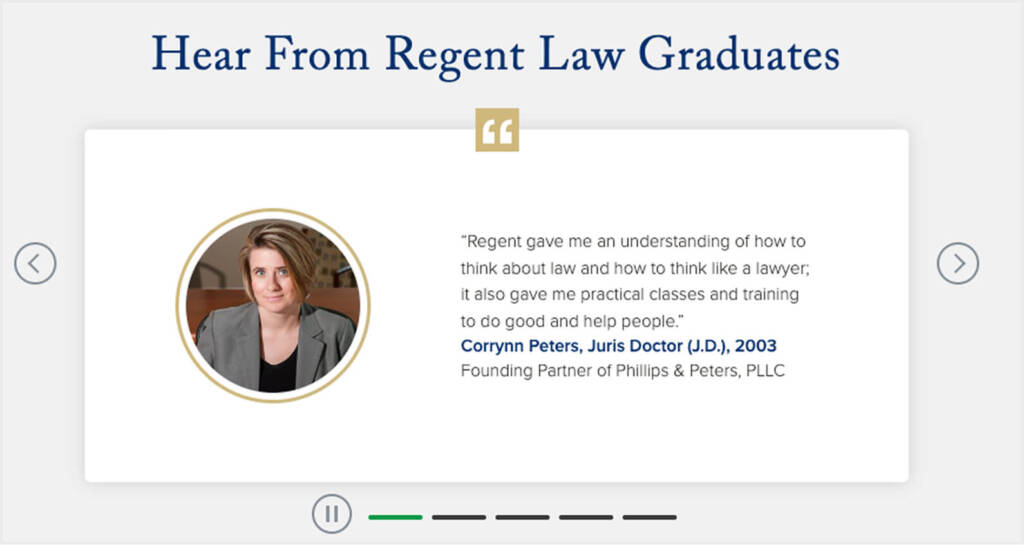
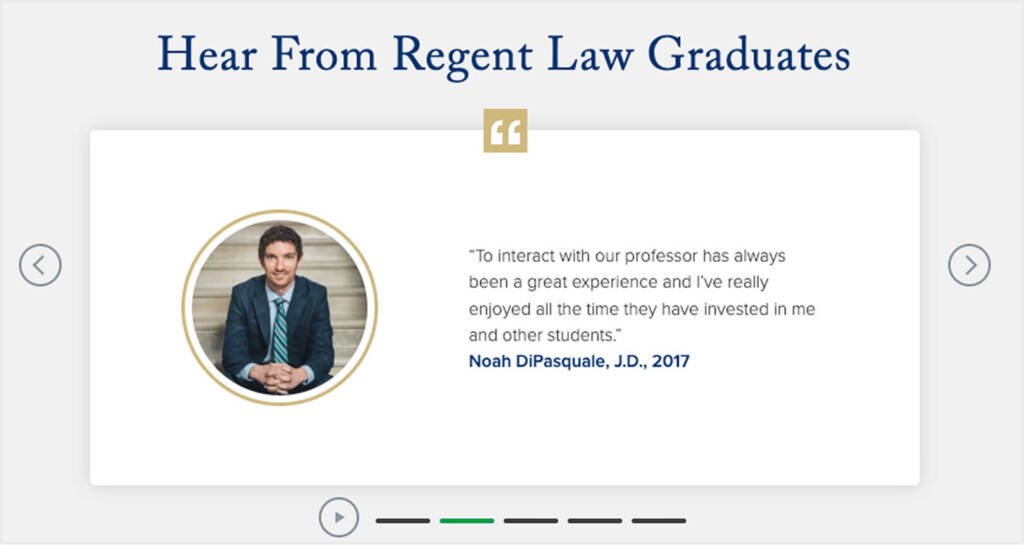
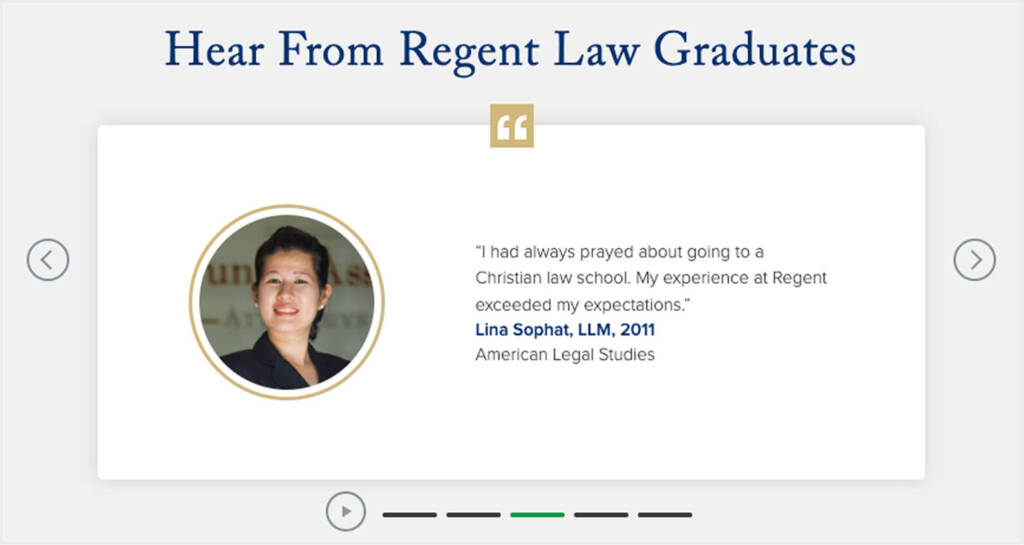
Regent uses attributed student testimonials, but placing them at the bottom limits their impact.
What’s missing from most examples is intentional placement and strategic alignment with the surrounding page content. Testimonials shouldn’t be used as filler; they should reinforce your program’s differentiators and help prospects see themselves in your students’ success.
Takeaway: Use testimonials strategically: Place them near decision-driving content (such as CTAs or program highlights), and ensure they’re visually engaging, specific, and clearly attributed. When done well, social proof builds trust and can nudge hesitant visitors to convert.
6. Key program details are still getting left off the page.
Prospective students are looking for clarity, but many law school landing pages make them dig for basic facts. In our analysis, only 44% of pages mentioned program duration, and just 15% listed tuition. Other critical factors were also missing from most pages: Only 19% mentioned financial aid, 27% referenced scholarships, and just 6% included any information about credit transfer options.
This lack of transparency creates friction. When users can’t find what they need within a few seconds, they’re likely to bounce or keep browsing — possibly on a competitor’s site.
The best pages made key facts obvious. Several online JD and MLS programs led with clear breakdowns of time to completion, credit requirements, or tuition per credit. These details weren’t hidden in PDFs or fine print. Instead, they were formatted for scanning and often found near the top of the page.
Programs that failed to include these elements missed a chance to build trust. Vague claims, such as “affordable tuition” or “flexible format,” don’t carry weight without specifics, especially for price- and time-sensitive students.
Tip: Don’t make students hunt for essential info. Surface cost, time, and transfer credit details early and make them easy to understand at a glance. If your program is affordable, fast, or flexible, prove it.
7. Many schools are underselling their own credibility.
Law school is a high-stakes investment in time, cost, and career trajectory. For prospective students comparing programs, outside validation carries weight. Yet in our analysis, only 42% of landing pages highlighted rankings, awards, or credentials.
That means the majority of schools are leaving out some of the clearest signals of quality and legitimacy. Accreditation, bar passage rates, national or regional rankings, and employer recognition can all help students feel more confident in their decision. Without those cues, even strong programs can come across as generic.
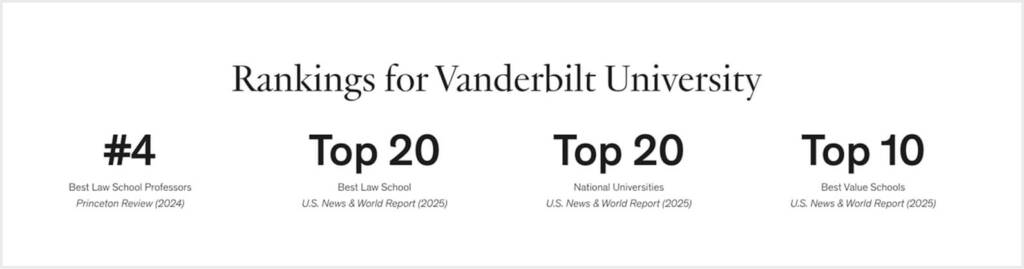
A few schools got the content right but not always the placement. Vanderbilt featured its Top 20 U.S. News & World Report ranking, along with faculty accolades, but placed those details at the very bottom of the page. This kind of content builds trust, but only if users see it before they bounce.
Albany Law highlighted its legacy, government recognition, and employment outcomes, yet tucked this information deep in the scroll, below less persuasive content. These are strong credibility markers, but when buried, their impact is lost.
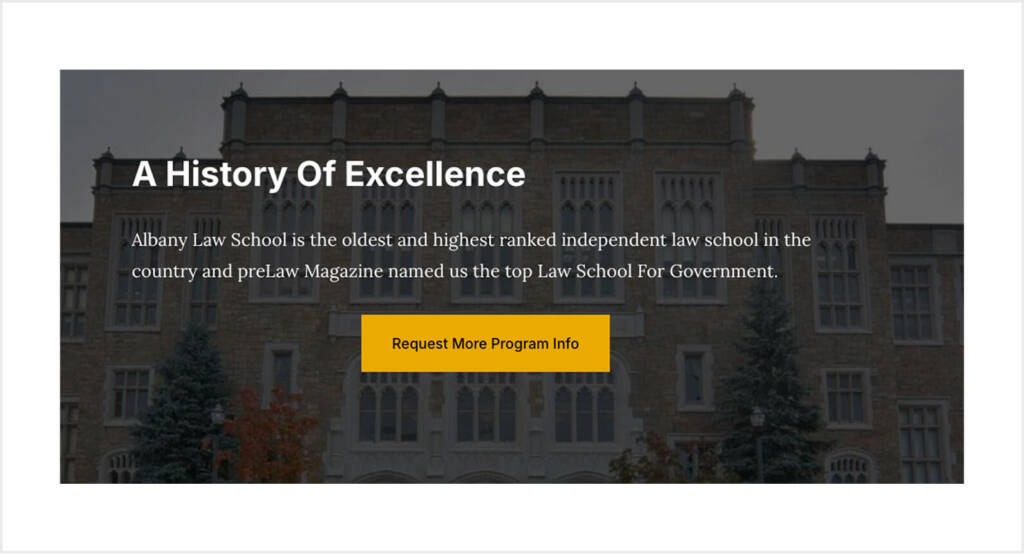
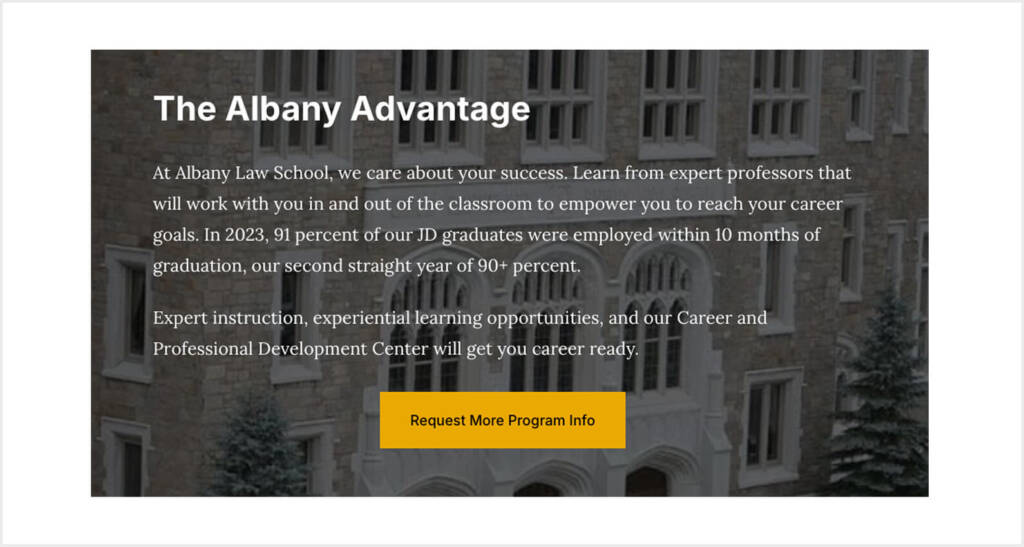
Albany Law features strong proof points but buries them mid-scroll, where users might miss them.
Law school applicants are doing their homework. They want to know: Is this school respected? Will this degree open doors? If your page doesn’t answer those questions quickly, you’re at risk of losing interest before a prospect even inquires.
Takeaway: Don’t bury your proof points. Use rankings, credentials, or other third-party validations to build trust fast, especially for students who are skeptical or comparing you to better-known names.
8. Video is still rare, and that’s a missed opportunity.
Video can be one of the most powerful tools on a law school landing page. It builds trust, humanizes the experience, and helps prospects picture themselves in your program. But most schools aren’t using it.
Only 19% of the pages we reviewed included any video at all.
That’s a missed opportunity, especially when you consider how often law school applicants are comparing programs on intangibles such as culture, support, and fit. A short clip from a professor, alum, or current student can do more in 30 seconds than a paragraph of text. It gives your page energy. It shows, rather than tells.
Even among the schools that included video, execution varied. A few buried it low on the page or reused a general university promo that didn’t feel tailored to the law program. Others embedded video near key decision points, such as the form or CTA, which is more effective.
For online and hybrid JD or MLS programs in particular, video is a chance to make your offer feel more real and to help prospects understand what your experience actually looks and feels like.
Tip: If you want to stand out, add video. Use it to reinforce your program’s value, show real people, and answer the unspoken questions prospects are asking. And place it where it matters, not as an afterthought but a conversion tool.
9. Mobile friction is a conversion killer.
For most law schools, paid ads lead to one place: the landing page. And for many prospects, that first click happens on a phone. If your mobile experience is clunky, slow, or confusing, you’re losing qualified leads before they even read your headline.
We scored each landing page on a 1–10 scale for mobile usability. The average? Just 6.4.
Even more telling: 46% of pages scored below 6. That kind of UX friction kills momentum. Mobile users are less patient, more distracted, and quick to bounce if a page doesn’t load fast, look clean, and scroll easily.
The biggest offenders? Overly long forms, walls of unformatted text, buttons that were too small or poorly placed, and layouts that didn’t adapt well to different screen sizes. A few schools nailed it with responsive design, short forms, sticky CTAs, and clear spacing, but they were the exception.
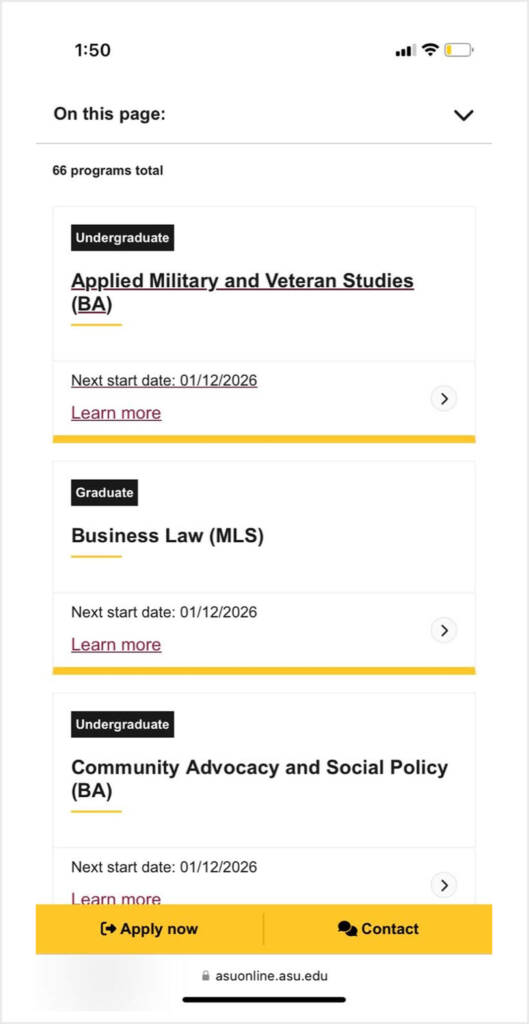
Arizona State University (ASU Online)
The fixed sticky footer with “Apply now” and “Contact” CTAs is a nice touch, but on small screens, it takes up a lot of space and can feel cramped.
Combined with the dense list of programs and minimal white space, the page feels more functional than friendly.
A bit more breathing room and clearer visual hierarchy could go a long way in improving the mobile experience.
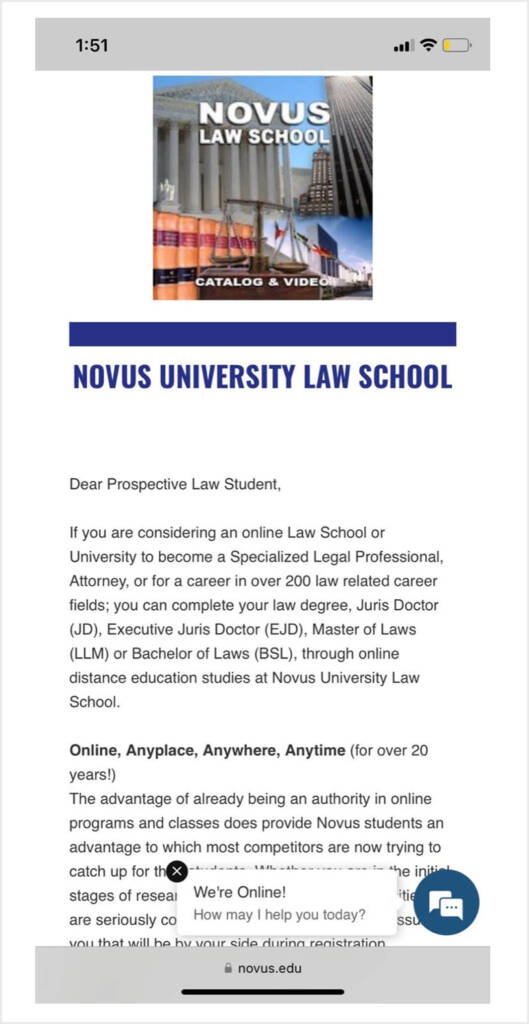
The landing page opens with a block of text and dated visuals, which can be hard to process on mobile.
The dense copy and lack of clear headings or scannable sections make it difficult to engage quickly.
Breaking up the content and adding clearer calls to action could help users navigate more easily, especially on smaller screens.
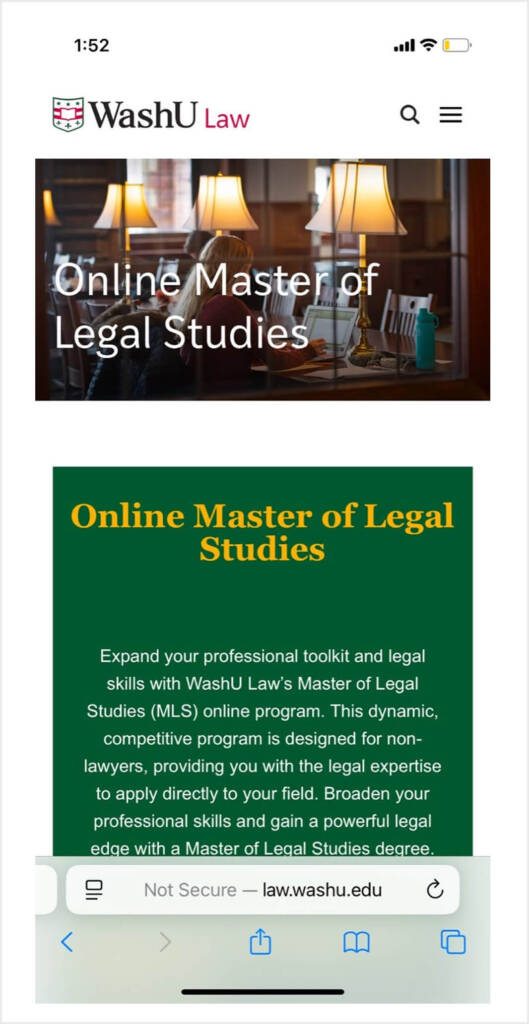
Washington University in St. Louis (WashU Law)
The page loads with solid content and a reputable brand, but the formatting feels dated, tight, and text-heavy on mobile.
The font size, paragraph length, and color contrast aren’t as mobile-optimized as they could be.
Shortening the intro or using collapsible sections could help users get the information they need without so much scrolling.
With law school prospects doing more of their research on mobile, a poor experience isn’t simply annoying. It signals a lack of attention to detail and weakens your brand.
Takeaway: Audit your mobile experience ruthlessly. Your page should be fast, frictionless, and easy to navigate, especially for users who are just starting their research and aren’t ready to commit.
Best practices for law school landing pages
Not every issue we saw during this study showed up in the stats. Some patterns — layout choices, missed opportunities, subtle friction points — emerged from repeated observation.
If you’re creating or refining a landing page for a JD, MLS, or LLM program, here’s what we recommend.
1. Lead with the essentials
Cost, duration, and outcomes are top of mind for every prospective law student. Don’t make them hunt for the answers. Place key details where they’re easy to spot, ideally near the top of the page and again wherever context makes them relevant.
2. Use testimonials and proof points with purpose
Instead of tacking them on at the bottom, integrate testimonials, stats, and recognitions into the page narrative. For example, pair a student quote with your program highlights, or put a job placement stat near the outcomes section. These elements work best when they reinforce the surrounding message.
3. Make the page easy to skim
Visitors aren’t necessarily reading every word on the page. They’re often scanning for the information that matters most to them. Use clear section headers, short paragraphs, and structured blocks to guide the eye. Avoid long text walls or generic labels such as “Why Choose Us.”
4. Design smarter forms
The best forms feel effortless, even when they’re collecting meaningful data. Limit the number of fields and, if you need more information, use multi-step logic to reduce initial friction. Make sure the CTA tells the user what they’ll get in return.
5. Optimize for mobile first
Law school prospects are doing more of their research on their phones. That means forms, buttons, layouts, and navigation need to be touch-friendly and fast to load. A slow or clunky mobile experience often leads to a lost lead.
6. Connect cost to value
Tuition numbers on their own don’t build trust, but when paired with salary outcomes or alumni success stories, they do. Help users see the return on their investment by placing cost details near proof points and career outcomes.
7. Make your differentiators obvious
If your program offers something unique — flexible pacing, regional reputation, or a specific legal focus — don’t hide it halfway down the page. Surface it early and repeat it where it makes sense.
8. Create a reason to act now
A call to action is stronger when it’s paired with urgency. Use copy, such as “Classes start January 10” or “Application deadline: July 15” to nudge visitors toward making a decision.
9. Match the experience you’re selling
Your page’s design should reflect the experience you’re selling: clear, current, and credible. Let the page design, content tone, and visual choices signal what kind of law school experience a student can expect and make sure that impression builds confidence.
If your law school landing page isn’t doing the heavy lifting, now is the time to rethink it. Partner with a higher ed marketing agency that knows how to turn law school clicks into inquiries, and let’s build something better together. Start the conversation today.