A Data-Informed Look at a Growing Visibility Gap
Data sourced from SEMrush AI Visibility, June 18, 2026. Enrollment data from U.S. News & World Report and institutional sources, fall 2024.
Syracuse University is navigating one of the most difficult enrollment moments in its recent history. As the university examines what went wrong and what to fix, most of the conversation has focused on demographics, financial aid strategy, and the international student pipeline. There is a parallel question worth asking: how visible is Syracuse to prospective students in the AI-powered search environment where early-stage research increasingly happens? We pulled AI search visibility data for Syracuse and six peer institutions and adjusted the numbers for enrollment size. We found that Syracuse’s brand recognition is holding up, but the content infrastructure that drives AI citations is not keeping pace with competitors.
Key Takeaways
- Syracuse is facing a real enrollment crisis with multiple contributing factors. Chancellor Haynie has cited a shrinking pool of 18-year-olds, heightened competition for students, and a sharp drop in international enrollment, with international undergraduates falling from 12% to just 5% of the entering class in two years. These headwinds are not unique to Syracuse, but the financial exposure is significant given how heavily the university depends on tuition revenue.
- The more precise problem appears to be yield, not applications. Almost 47,000 first-year students applied for the Fall 2025 semester. With an acceptance rate of around 42 to 46%, Syracuse is still admitting a large share of applicants, but first-year yield has decreased to almost 19%, a drop of 13% over the last decade. This suggests that accepted students are increasingly choosing other schools, or opting out altogether. That is a brand and decision-stage problem as much as a recruitment problem.
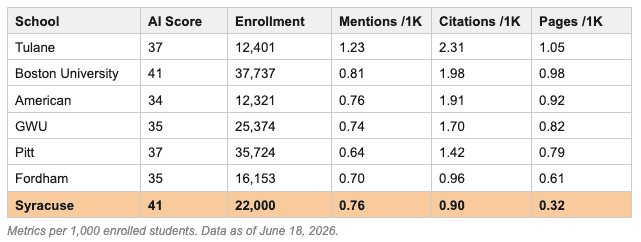
- In terms of AI search visibility (adjusted for enrollment size), Syracuse falls to last place on citations per 1,000 students (0.90) and cited pages per 1,000 students (0.32). At 0.32 cited pages per 1,000, Syracuse has less than a third of Tulane’s rate, meaning AI platforms are drawing on far fewer Syracuse pages when generating answers prospective students are likely to encounter.
- Competitors with smaller enrollments are outperforming Syracuse on AI visibility and content authority. Tulane, with roughly 12,400 students, generates 2.31 citations per 1,000 students. American University, a direct peer in communications and public affairs, generates nearly twice Syracuse’s citations per 1,000 despite carrying a lower raw visibility score.
A Difficult Moment for Syracuse
Syracuse University made national higher education news this month after Chancellor J. Michael Haynie sent a frank message to faculty and staff acknowledging the university would miss its fall 2026 undergraduate enrollment targets and that the shortfall would produce a budget deficit, the first in quite some time.
The causes are real and not entirely of Syracuse’s making. Haynie pointed to heightened competition for students, a shrinking pool of 18-year-olds, and a sharp decline in international and graduate student applications driven by visa difficulties, geopolitical pressures, and federal policy disruptions. These are challenges facing universities nationwide. As Higher Ed Dive reported, international undergraduates fell to just 5% of Syracuse’s entering class, down from 12% just two years ago, a significant structural exposure for an institution that had built much of its enrollment model around attracting students from abroad.
There is a second dimension worth examining separately. Syracuse attracted almost 47,000 applicants for the Fall 2025 semester, a 13% increase in applicants since 2021. Syracuse’s acceptance rate has hovered around 42 to 46% in recent years. That means the university is not significantly undersupplying offers of admission. If acceptance volumes held roughly steady or increased while enrolled headcount declined or stagnated, the more precise diagnosis is a yield problem: accepted students are choosing other schools. That is a different challenge than attracting applicants, and it calls for different interventions. One of those interventions is brand presence at the decision stage, which is exactly where AI search visibility plays a growing role.
What AI Search Visibility Measures and Why It Matters Now
The metrics below come from SEMrush’s AI Visibility tool, pulled on June 18, 2026, with worldwide settings across all AI platforms. The tool tracks three core signals:
- Mentions: how often a school’s name appears in AI-generated responses across platforms including ChatGPT, Google AI Overview, Google AI Mode, and Gemini.
- Citations: how often AI platforms actively cite a school’s content as a source when generating answers.
- Cited Pages: the number of distinct pages from a school’s website that are being pulled into AI-generated responses.
Of the three, cited page volumes is the most meaningful signal for content strategy. It measures the depth of a school’s footprint inside AI systems, specifically how many pages are considered authoritative enough to reference. Mentions reflect brand recognition; cited pages reflect content authority.
The composite AI Visibility score (0-100) weights these signals together but is heavily influenced by brand name recognition. That is why the per-enrollment adjustment tells a more honest story.
Syracuse AI Search Visibility Data: Raw Numbers
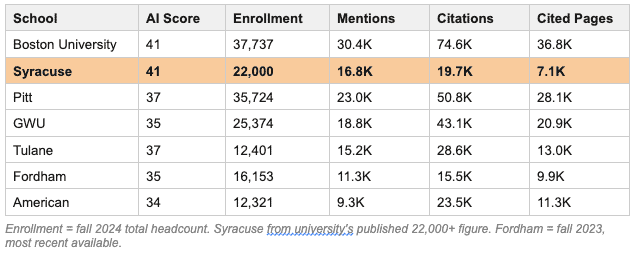
In raw terms, Syracuse appears mid-pack. It ties BU on the AI score, sits between Pitt and Tulane on mentions, and only Fordham and American trail it on citations. This is roughly where a university of its size and brand recognition would be expected to land.
The raw numbers become more interesting and more concerning when you account for scale.
Syracuse AI Search Visibility Data: Enrollment-Adjusted
Adjusted for enrollment, the story changes significantly.
Tulane moves from the middle of the raw pack to clear first place. American University, which scores four points below Syracuse on the composite index, generates more than twice the citations per 1,000 students. And Syracuse, despite its brand recognition advantage, sits last on cited pages per 1,000 by a wide margin: at 0.32, roughly a third of BU’s rate and less than a third of Tulane’s.
Why per-1,000 enrollment?
Raw visibility numbers are shaped by institutional size. A large university with 37,000 students generates more web content, more press, and more AI references simply by operating at scale. Dividing by enrollment per 1,000 students normalizes for that, giving a cleaner read on how well each school is reaching its target audience relative to the size of that audience. It measures visibility efficiency, not just visibility volume.
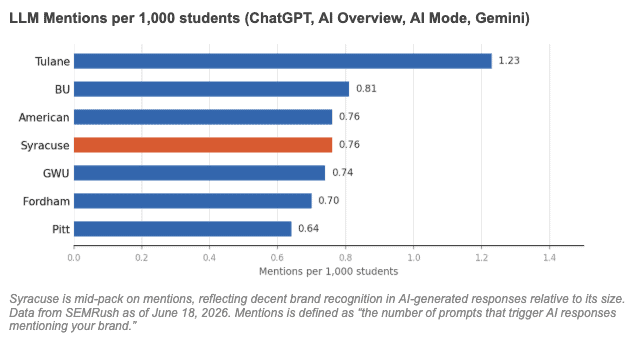
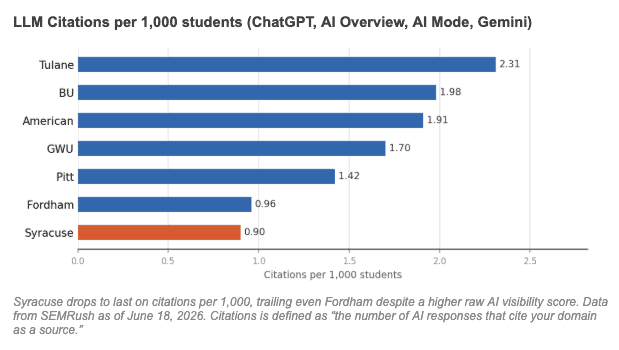
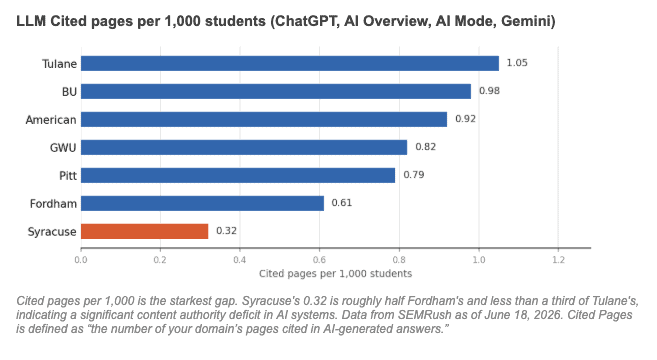
The cited pages gap is the number that deserves the most attention. A school’s brand name being mentioned by AI platforms reflects decades of reputation-building. The pages being cited reflect what is happening right now: which institutions have invested in content that AI systems consider worth referencing when a prospective student asks about communications programs, public affairs schools, or graduate options in the Northeast.
By that measure, Syracuse’s competitors are pulling ahead in the space where future students increasingly do their research. A prospective student asking ChatGPT or Gemini to compare graduate programs or recommend schools in a particular field is more likely to see BU, Tulane, or American cited as sources than Syracuse. Not because Syracuse is a lesser institution, but because its web content is being treated as less authoritative by AI platforms.
This is not a cause-and-effect claim about fall 2026 enrollment. The yield problem Syracuse acknowledged has multiple causes, and AI search visibility is just one variable among many. But for a university that now faces a budget deficit and needs to win back yield from accepted students who are choosing other schools, improving AI visibility is one of the more actionable levers available, and one that competitors are currently outperforming on.
The ChatGPT Mention Deficit
At 0.12 mentions per 1,000 students, Syracuse is last on ChatGPT. For a school Syracuse’s size, 0.12 is the weakest adjusted performance in the group.
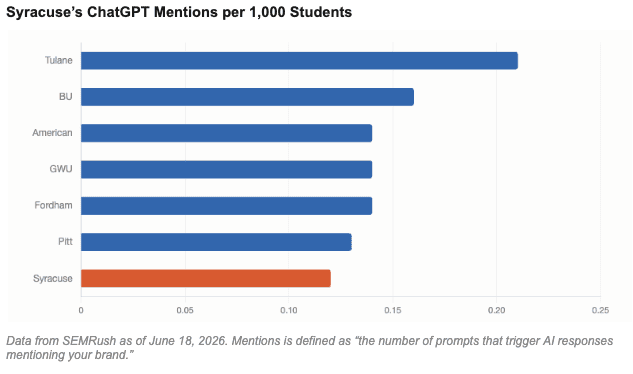
This matters for melt because ChatGPT is where admitted students do comparison research. A student who has already received an acceptance letter from Syracuse and two competing schools is not browsing brochures. They are asking AI tools open-ended questions: which school has the stronger communications program, what do alumni say about career outcomes, how does the financial aid package compare. Those are exactly the queries where cited pages drive the answer. If Syracuse’s content is not being pulled into those responses, the school is effectively absent from one of the most consequential conversations in the enrollment funnel. The student sees BU, Tulane, or GWU cited as authoritative sources. Syracuse is not in the room.
What’s Next for Syracuse’s AI Visibility?
With a recent EAB survey suggesting that 46% of prospective students used AI tools during their Fall 2025 college searches — up from only 26% in the spring of 2026 — a well-executed AI visibility strategy is becoming an increasingly relevant tool for influencing not just awareness but decision-making. Because much of what surfaces in AI-driven search comes directly from university websites, architecting content that speaks to what ideal students care about most when comparing institutions and deciding where to attend can meaningfully move the needle on yield and enrollment, not just applications.
By combining data-driven investigation into AI search terms with persona-based research and insights, Syracuse and similar universities can create new content that answers prospective students’ questions about whether the institution is a good match, leading to better-fit applications and higher yield.