If you’re running Meta ads for a law program in 2025, your prospects are seeing a lot of competition in their feeds. Online JDs, hybrid JDs, MLS, LLM, certificates, “no LSAT,” “best value,” “top ranked,” “practice from anywhere,” all stacked between vacation reels and meme accounts. The scroll window is tiny, and every impression has to earn its place.
To see how well law schools are using that window, we reviewed Meta ad campaigns from 50 of the top U.S. law programs across Facebook and Instagram. We analyzed each ad for creative format, imagery, messaging, social proof, and differentiation, then compared what we saw against current Meta best practices and what we know converts for higher ed brands.
The results show a clear pattern: Law schools are investing heavily in Meta as a channel, but many ads lean on generic imagery, soft value props, and underused tools. A smaller group stands out with sharp positioning, vertical-first creative, strong rankings and outcomes, and messaging built for working professionals and ROI-focused candidates.
This report breaks down those patterns, calls out where institutions are leaving inquiries on the table, and outlines what enrollment and marketing teams can do right now to turn Meta from “nice-to-have awareness” into a reliable driver of leads and applications.
| Key Takeaways | |
Meta Ads Snapshot: How 50 Law Schools Show Up in the Feed
Before we get into what needs to change, it helps to see where law schools are starting.
Across 50 Meta ad campaigns from top U.S. law programs, five patterns appeared again and again:
- Polished, safe visuals dominate
Most creative features staged campus photography: students in libraries, mock courtrooms, or leafy quads; graduates in caps and gowns; wide shots of buildings. A handful of institutions (Nebraska’s “Day in the Life,” Colleges of Law, a few testimonial clips) lean into more authentic, social-native visuals, but they are the exception. - “Flexible” and “online” lead the message
Many ads highlight format first: 100% online JDs, hybrid and part-time options, MSL/MLS programs for non-lawyers, certificates in niche areas such as environmental law or healthcare compliance. Flexibility is front and center, but often without a clear statement of who the program is for or why it beats competing options. - Social proof is strong, but uneven
Several institutions use rankings, bar passage rates, employment stats, or alumni network size directly in creative assets (UMKC, Liberty, Vermont Law, Texas A&M, Purdue Global). Others rely on vague claims such as “top-tier” or “world-class” without visible third-party validation. Graduation photos often appear without the context that can help turn them into trust signals. - CTAs are clear, but not always matched to intent
Most campaigns use platform-native CTAs such as “Learn More,” “Apply Now,” “Sign Up,” or “Register.” That’s good. Here’s where the gap occurs: Many top-of-funnel ads (general brand or awareness messages) still jump straight to “Apply Now,” while info sessions, guides, or mid-funnel offers are underrepresented. - Formats show effort, but not full potential
We see single-image ads, some carousels, and a growing number of videos. However, many videos feel like repurposed B-roll or slow campus walkthroughs instead of thumb-stopping Reels built for mobile viewing. Vertical-first, story-driven creative is still sporadic, even for programs aimed at working professionals who live on their phones.
Taken together, this snapshot shows that law schools are present on Meta, they are spending, and they understand the basics. The opportunity is to sharpen creative, proof, audiences, and funnel strategy so these campaigns work harder for inquiry, application, and yield goals.
Strategy 1: Use Proof and Positioning That Actually Mean Something
Prospective law students are skeptical by default. They compare rankings, outcomes, bar passage rates, locations, formats, and cost across multiple tabs. Generic claims, such as “top-tier legal education” or “world-class faculty,” disappear into the scroll.
In the ads we reviewed, two groups emerged:
- Programs that back up their promise with specific, scannable proof
- Programs that expect “flexible,” “rigorous,” or “top-ranked” to do the heavy lifting on their own
Here is what strong proof looks like in the feed, based on real ads from our sample:
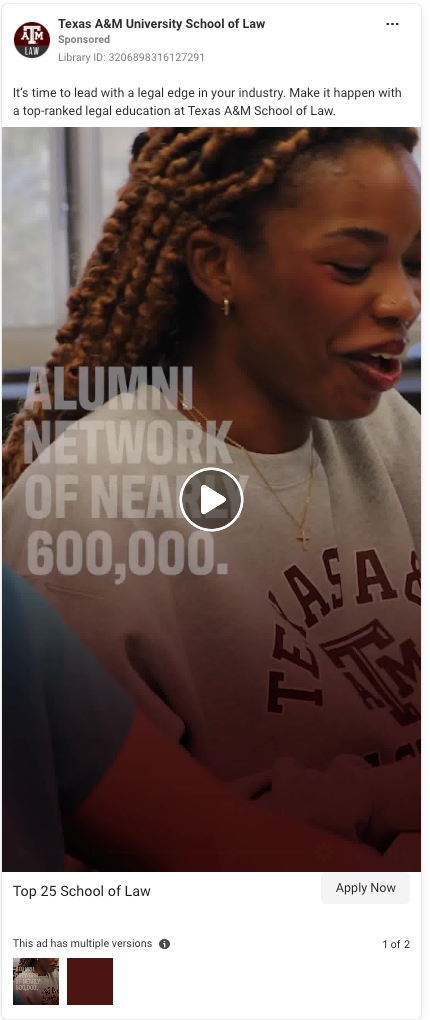
- Texas A&M Law highlights a “Top 25 School of Law” callout and an alumni network approaching 600,000, turning brand perception and connections into a clear advantage.
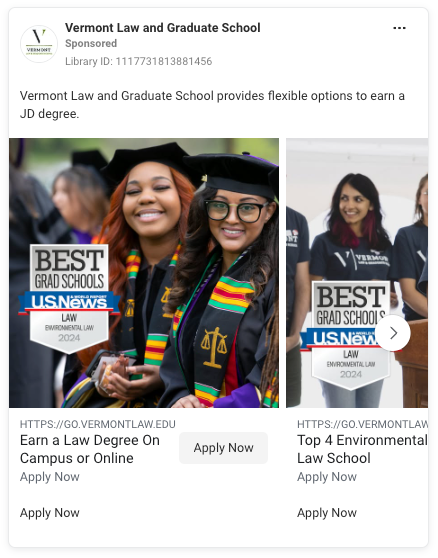
- Vermont Law and Graduate School uses environmental law rankings and U.S. News badges to support its niche claim.
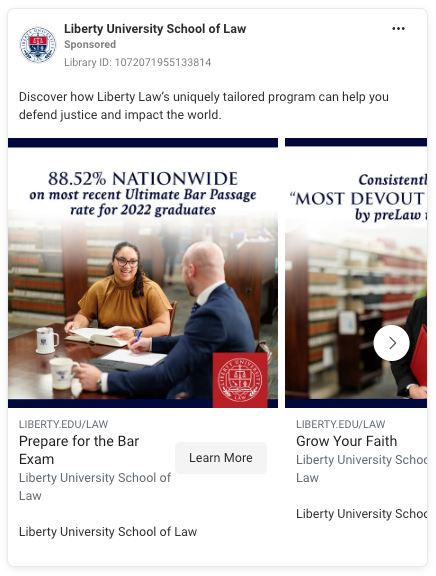
- Liberty Law leans on an 88.52% Ultimate Bar Passage rate and faith-based positioning, giving prospects a concrete and emotional reason to care.
- UMKC Law stacks proof with “22nd Best-Value Law School,” scholarship prevalence, lower average debt, and strong employment, making “affordable” and “outcomes-driven” feel real.
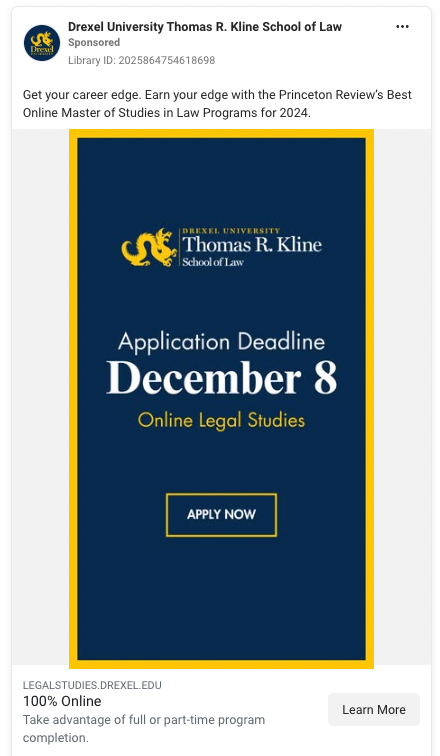
- Drexel Kline and Purdue Global reference recognition for online programs, reinforcing that “online” does not mean “second tier.”


On the flip side, many campaigns show graduation photos, city skylines, or smiling students with copy that could belong to any institution. Without a number, badge, or named outcome, those ads burn impressions without building trust.
To tighten proof and positioning, law schools should:
- Lead with one or two concrete facts:
- Bar passage rate
- Employment rate within a defined timeframe
- Recognized ranking or badge
- Distinctive niche (e.g., environmental, IP, tech/AI, health law)
- Put those facts directly in the creative:
- Use large, legible stats or badges inside the first frame of an image or video
- Pair every “flexible,” “online,” or “best value” claim with a specific qualifier:
- “100% online JD designed for full-time professionals working 40+ hours a week”
- “Scholarships for 98.6% of students; average debt 20% below national average”
- Reserve generic phrases for no one:
- If “top-tier” or “world-class” appears, it should sit beside a third-party source, not stand alone
Strong proof attracts students who recognize fit and seriousness early, improving click quality, lead quality, and downstream enrollment.
Strategy 2: Swap Stock-Style Creative for Real People and Real Proof
The strongest law school ads in our sample feel like something a prospect might actually stop and watch in their feed. The weakest look like brochure covers repurposed as ads.
Across many campaigns, we saw:
- Polished but interchangeable shots of students with laptops.
- Buildings at sunset with overlay copy.
- Graduation photos that could belong to any institution.
- Generic visuals paired with generic lines about “flexibility” and “rigor.”
A smaller set of campaigns broke that pattern with assets closer to social-native content:
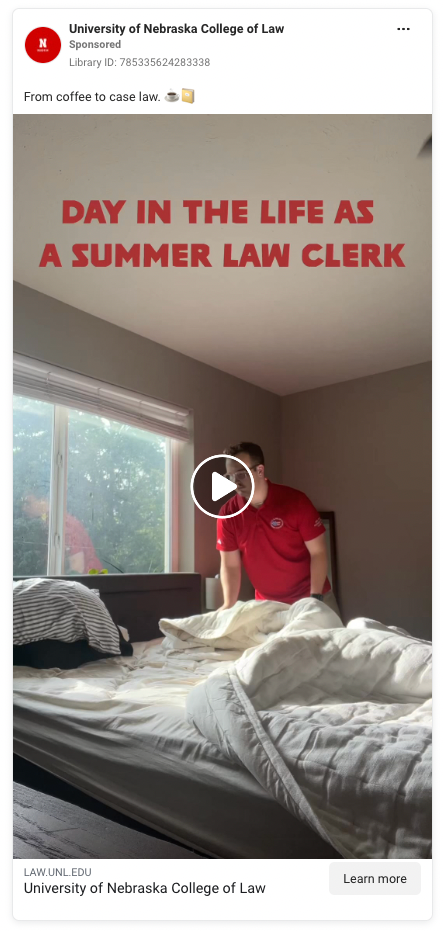
- Nebraska Law’s “Day in the Life” style video that follows a student through a summer law clerk role, giving a clear sense of experience and outcome.
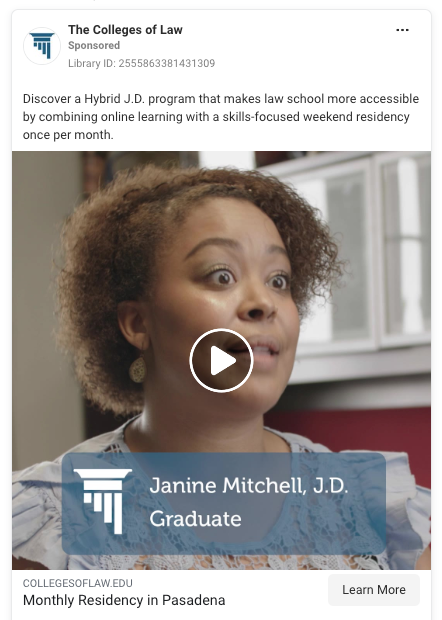
- The Colleges of Law using an on-screen graduate testimonial with a lower-third ID, which immediately feels more credible than a faceless quote.
- Miami Law highlighting specific experiential opportunities (Hague moot court, clinics, DOJ externship) through a named student, connecting visuals, story, and proof.
- ASU, Texas A&M, Vermont Law, and others featuring faculty or students in context, not just in posed portraits.

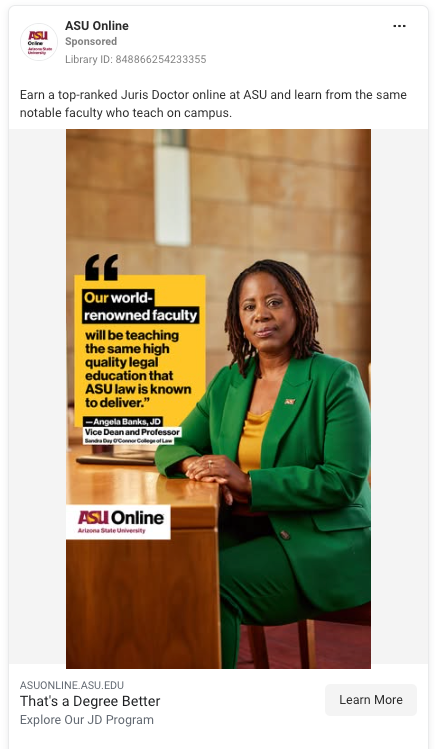
This shift matters because law school prospects are filtering hard for “Is this real?” Ads that look like stock or catalog photography signal caution. Ads that show identifiable people, specific experiences, and real moments signal trust.
To move creative away from stock vibes and toward credible stories, law schools can:
- Feature named students, alumni, and faculty:
- Use on-screen lower-thirds with name, program, grad year, and role or employer.
- Align their story with a concrete outcome (clerkship, firm, public interest role, career pivot).
- Show the experience, not just the campus:
- Clinics in action, moot court, externships, online classrooms, faculty interactions, city immersion
- Short clips or carousels that each reveal one clear moment or benefit
- Embrace social-native formats:
- Vertical video, quick cuts, overlaid captions, direct-to-camera clips
- Lo-fi is fine if it is clear and on brand; authenticity beats over-produced sameness
- Use visuals to reinforce the differentiator:
- Environmental law? Show fieldwork or advocacy settings.
- Online JD for working adults? Show real professionals studying between shifts.
- Faith-based program? Show how that community shows up in daily life, not only in taglines.
- Retire one-size-fits-all creative:
- If an image could work for any institution or any program, it is not doing enough.
The goal is straightforward: help the right prospect recognize themselves in your story, trust what they see, and feel confident enough to click or inquire.
Strategy 3: Design Every Ad for Mobile-First Attention Spans
Most of your prospects are meeting these ads on a phone, in motion, and half-distracted. Meta’s own research shows people spend barely a couple of seconds on a single post before scrolling on. In our sample, a noticeable share of law school ads still look like they were designed for desktop or a brochure, then squeezed into a square.
Common issues we saw:
- Dense text overlays that shrink to an unreadable size on mobile.
- Horizontal or wide shots where the subject is tiny in-frame.
- Rankings, deadlines, and proof points buried in small type or secondary frames.
- Video that opens with slow pans of buildings instead of a hook prospects can grasp instantly.
To make Meta creatives work in that tiny decision window, campaigns should prioritize a handful of specific adjustments.
| Focus Area | What to Do | Example / Reminder |
|---|---|---|
| Mobile-first layout | ||
| First-second hook | ||
| Copy + creative alignment | If the visual sells outcomes, the text should reinforce outcomes, not switch topics | |
| CTAs & tap behavior | Choose CTAs suited to the stage (Sign Up, Get Program Guide, Apply Now) and send clicks to fast, mobile-friendly pages | A strong ad pointing to a slow, cluttered page still loses qualified prospects |
When law schools design directly for mobile behavior instead of resizing print-era creative, their Meta ads become easier to notice, easier to understand, and easier to act on in the few seconds that matter.
Strategy 4: Match Creative and CTA to the Funnel
A surprising number of the paid media placements in our sample behave as if every viewer is seconds away from submitting an application. The creative is focused on general awareness, the audience is likely broad, but the CTA is “Apply Now.”
That shortcut leaves a lot of qualified prospects behind.
Most future law students move through distinct stages:
- Awareness: “Law might be right for me. Which paths exist?”
- Consideration: “Which programs fit my goals, schedule, and budget?”
- Decision: “I’m choosing between two or three schools. Who earns my application or deposit?”
Strong Meta strategies align message, creative, and CTA with those stages. Many of the ads we reviewed blend them together. For example, an institution introduces itself for the first time with a generic campus shot and immediately pushes “Apply.” Another promotes a niche online program without offering a simple way to learn how it works before asking for a full application.
To fix that mismatch, law schools can structure Meta campaigns around a clear funnel.
Start by defining stage-specific roles:
| Funnel Stage | Use Ads to… | Example Creative | Suggested CTAs |
|---|---|---|---|
| Awareness | Introduce who you are and why you’re different | ||
| Consideration | Answer serious questions for engaged prospects | ||
| Decision | Nudge high-intent users to complete the next step |
Then, make Meta’s tools work toward that structure by:
- Building remarketing pools from video views, landing page visits, and lead form completions
- Using lookalikes based on started or completed applications, not only page traffic
- Sequencing creative so prospects see deeper offers over time, instead of the same generic ad for months
When creative and CTAs are aligned with where someone is in the decision process, Meta stops feeling like a one-note awareness spend and starts functioning like an enrollment funnel with clear next steps at every touch.
Strategy 5: Use Targeting, Data, and Automation Intentionally (Not Automatically)
From the outside, Ads Library does not expose every setting, but the creative and messaging in our sample give strong hints. Many law school Meta campaigns look broad: generic headlines, one-size-fits-all value props, and CTAs aimed at everyone from high school seniors to mid-career professionals.
At the same time, current best practices lean heavily into AI, Advantage+ audiences, and broad targeting. Without a clear plan, that combination can drive impressions without delivering qualified prospects to enrollment teams.
For law schools, targeting and automation work best when they are anchored to real data and real segments.
Start by defining who each campaign is for. Typical audiences include:
- Traditional JD prospects exploring full-time programs
- Working professionals considering online or hybrid JDs
- Non-lawyers evaluating MLS/MSL programs
- International students looking for specific visa or bar outcomes
- Candidates drawn to focused areas such as environmental, IP, or tech law
Once those groups are clear, campaigns can use Meta’s tools with more precision.
Before scaling budget, align your setups with approaches that reflect current Meta best practices:
| Approach | How to Use It | What to Watch For |
|---|---|---|
| Broad & Advantage+ with strong signals | ||
| Value-based lookalikes & remarketing | ||
| Audience alignment with creative | ||
| Guardrails on automation |
When institutions treat Meta’s automation as an amplifier for clear audience strategy and solid data, rather than a shortcut, campaigns become more efficient and bring in prospects who are far closer to enrollment goals.
Strategy 6: Use Video and Reels to Tell Fast, Specific Stories
Short-form video is where your future applicants spend their time, yet many law school Meta campaigns either skip it or treat it like a slow campus commercial. In our sample, a few programs leaned into Reels-style content and testimonials, while others opened with wide drone shots, long pans, and quiet music that never earn attention in the feed.
Video performs best when it behaves like content, not a TV spot. For law schools, that means giving prospects quick, concrete reasons to care, and doing it in formats built for vertical viewing.
Here’s how to bring campaigns closer to current best practices:
| Focus Area | What to Do | Example/Notes |
|---|---|---|
| Hook first | ||
| Vertical & silent-friendly | ||
| Format by funnel stage | ||
| People over buildings | ||
| Test & iterate consistently |
When law schools treat video as a fast, specific storytelling tool tailored to mobile behavior, Meta stops serving forgettable background footage and starts surfacing narratives that pull the right applicants into the funnel.
Strategy 7: Build a Law-Specific Meta Playbook on Outcomes, Integrity, and Transparency
Law school prospects are making one of the highest-stakes education decisions out there. They read employment reports, track bar passage data, and scroll Reddit threads. Generic higher ed messaging is not enough for this audience, and several campaigns in our sample miss that distinction.
Across the ads we reviewed, a pattern surfaced: Many schools use the same frames and phrases regardless of program type, audience, or price point. A full-time T14 JD, an online MLS, and a regional hybrid JD often share nearly identical creative and copy, even though the questions those audiences ask are very different.
A law-focused Meta strategy should answer what serious applicants actually want to know.
Start by aligning ads with law-specific decision drivers:
| “Will this degree pay off?” | Use employment rates, clerkship placements, practice area examples, salary bands where appropriate, and real alumni outcomes. Place these elements in the creative, not only on the landing page. |
| “Can I pass the bar and practice where I live?” | Where applicable, surface bar passage performance, jurisdiction notes, and support structures (bar prep, advising, academic success). Avoid vague claims about “rigorous academics” without evidence. |
| “Can I fit this into my life?” | For online, hybrid, and part-time programs, be concrete: |
| “Is this program serious and accredited?” | Reinforce accreditation, recognitions, and institutional history in a clear, scannable way. Law is highly regulated; ads should reflect that maturity. |
Differentiate by audience rather than defaulting to one message:
| For Working Professionals | For International Students | For Niche Programs (environmental, IP, tech, health law) |
|---|---|---|
Hold a higher standard for clarity and honesty:
- Avoid fuzzy affordability claims. If you say “affordable” or “best value,” anchor it with tuition ranges, scholarship prevalence, or comparative debt outcomes.
- Keep copy and creative aligned with what prospects will see after the click. A sharp ad that leads to a vague, outdated page erodes trust fast.
When Meta campaigns reflect the real stakes and questions of law school prospects, ads stop feeling like generic higher ed promotions and start functioning as credible, specific invitations to explore the right programs.
Meta Ads Checklist: Is Your Law School Campaign 2026-Ready?
Use this checklist as a quick audit. If your answer is “no” or “not sure” on several items, you have realistic opportunities to improve performance and lead quality.
Foundations
Confirm these first before scaling spend:
- Our campaign objectives match real outcomes (inquiries, started apps, enrollments), not vanity metrics
- Our tracking is set up to measure those outcomes accurately (pixel/CAPI, events, UTM discipline)
- Our ad clicks lead to mobile-optimized pages that load quickly and match the promise of the ad
Proof and Positioning
These items help prospects trust you quickly:
- At least one primary ad variant leads with a specific ranking, outcome, or recognition
- Where we claim “affordable,” “best value,” or “top ranked,” we show a stat or source in the creative or first lines of copy
- Our ads highlight program strengths that would clearly differentiate us from at least three peers
Creative and Messaging
Review how your ads look and read in an actual feed on a phone:
- Image and video assets are designed for vertical or 4:5 formats, not just resized horizontals
- On-image text is short, readable on mobile, and focused on one message per frame
- We feature real students, alumni, or faculty with names and roles where possible
- At least one campaign uses social-native video (Reels/Stories style) with a hook in the first second and captions included
Audience and Targeting
Check whether targeting aligns with how people choose law programs:
- We have distinct campaigns or ad sets for:
- Traditional JD prospects
- Working professionals
- Non-lawyer master’s/MLS audiences
- Any major niche programs (e.g., environmental, IP, health law)
- We use remarketing for:
- Visitors to program pages
- Prospects who started forms or applications
- Video viewers who watched a meaningful portion
- We test broad or Advantage+ style setups only where they are backed by quality, first-party data and clear conversion goals
Funnel Alignment
Ensure creative and CTAs fit where the user is in their decision process:
- Awareness ads focus on storytelling, outcomes, and reasons to explore, with CTAs like “Learn More” or “Watch Overview”
- Mid-funnel ads promote guides, info sessions, webinars, or program explainers with CTAs such as “Get Program Guide” or “Register”
- High-intent audiences see deadline-focused, scholarship-focused, or completion nudges with CTAs like “Apply Now” or “Finish Your Application”
Law-Specific Expectations
These items speak directly to serious applicants:
- At least some ads speak plainly about:
- Career outcomes and practice areas
- Bar passage support and, where relevant, performance
- Program structure (time expectations, online/hybrid format, residencies)
- Our messaging for online and hybrid programs addresses rigor and legitimacy, not only flexibility
If this checklist feels uncomfortable, that is useful information. It means your Meta spend can likely do more work for your JD, LLM, and MLS goals with focused adjustments rather than bigger budgets.
Where Vital Fits In: Turning Law School Scrolls into Inquiries
If your Meta campaigns look a lot like the ads in our study, you aren’t alone. The upside: the gap between “visible on Meta” and “Meta as a reliable enrollment channel” is fixable with better structure, sharper creative, and smarter use of data.
Here’s how our team supports law schools and graduate programs that want their ads to perform at that higher level.
We start by auditing your current efforts against the standards in this report. That includes creative, targeting, tracking, offers, and landing experiences, so we can see where spend is working and where it stalls.
From there, we build a law-specific Meta playbook that can include:
Full-funnel campaign architecture mapped to awareness, consideration, and decision stages for JD, LLM, MLS/MSL, and certificates
Creative systems for static, carousel, and Reels that feature real students, outcomes, and proof points while staying on brand
Audience strategy that blends broad targeting, Advantage+ (where appropriate), remarketing, and lookalikes built from your actual inquiry and enrollment data
Lead-gen and event campaigns that promote program guides, info sessions, webinars, and deadlines in ways that produce qualified prospects instead of noise
Tight alignment with your CRM and reporting, so your team can see which ads drive started applications, completed applications, and deposits
If you want Meta ads that work as part of your enrollment engine instead of a stand-alone awareness line item, this is the work we do every day.
Explore how we approach paid social for higher ed and see related research:
- University Paid Ad Landing Pages Study
- Instagram & Facebook Ads for Universities
- Application vs. Yield Season University Campaigns
- University International Student Marketing Ideas
- Higher Ed PPC Case Study: Marshall University
Or, skip straight to a practical next step: Have us review your current Meta campaigns for one flagship law program and outline what it would take to bring them up to the standard reflected in this study. We’re ready when you are. Let’s talk.