
Vital has been a Magento Certified Solution Partner since 2019, a recognition built on nearly two decades of enterprise-level integration, customization, and consulting work on Magento eCommerce websites.
What Does it Mean to Be a Magento Partner?
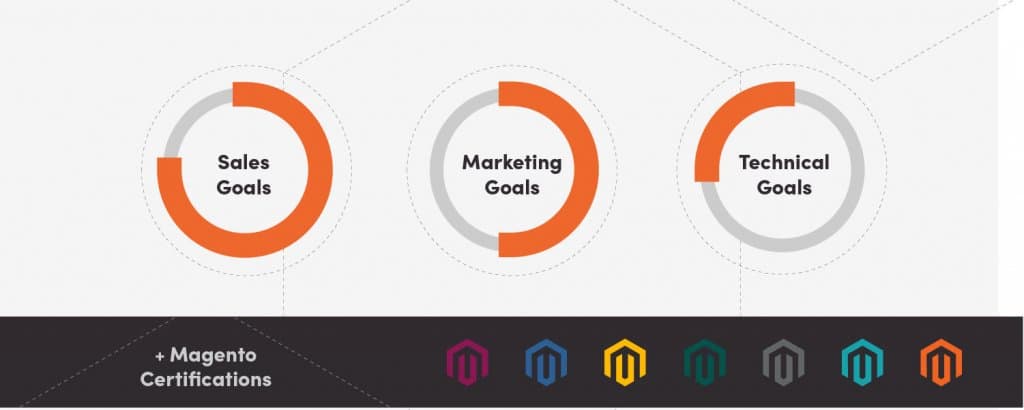
Our official recognition as a Magento Certified Solution Partner means we’re part of the platform’s global partner network of digital agencies, consulting firms, and developers, all top performers in their field.
We have an entire team of Magento-focused Vitalians who live in the platform every day. This team takes advantage of the many benefits that come with the partnership, including prime access to exclusive resources, ongoing education, and connections to Magento insiders.
Partnership Requirements
Becoming a partner is a rigorous process. We first had to submit our past Magento projects to prove that our technical prowess was up to their standards, and we had to make it crystal clear that we know the platform better than we know ourselves.
Partners are also required to meet strict KPIs, including sales, marketing, and technical goals, while keeping a set number of Magento-trained and certified resources in house. We were put through the ringer, but we passed Magento’s meticulous vetting process, and we’ve held that standard ever since.
Our Long History with Magento
The 2019 partnership made official what we’d already been doing for years.
Over nearly two decades, we’ve worked on 25+ Magento eCommerce website projects. We love Magento for its flexibility, scalability, and global developer community. The platform is built for deep integrations, from Salesforce and Microsoft Dynamics to Sage and Oracle Eloqua, so your store connects to the business systems you already run. And because Magento is an open-source PHP platform, businesses of any size can extend it to fit their needs as they grow.
So, why did we wait so long to make it official?
We never want to recommend anything to our clients under the assumption that we’re getting a kickback. If we’re going to partner with a provider, we’re going to do our due diligence to make sure that the company is forward-thinking and reputable, and that the partnership will be beneficial for our clients.
Holding off on a partnership with Magento was our way of making sure we were keeping our clients’ best interests at heart, even though we were still recommending Magento to many of them.
Adobe’s Acquisition of Magento
Our thinking changed in 2018, when Adobe purchased Magento for $1.6 billion. This acquisition was impossible to ignore, since Adobe is the brains behind top marketing and design tools including Illustrator, InDesign, Adobe Experience Manager (AEM), Photoshop, and countless others.
Adobe has long been regarded as a leader in content creation, advertising, marketing, and analytics. The acquisition of Magento brought them into the world of eCommerce, rounding out their ability to help clients create the best possible experiences throughout the entire customer journey in real time.
The Vital team trusts and uses many Adobe programs on a daily basis because of the company’s expertise with consumer-focused digital experience software. For the last decade, we’ve also been a cheerleader for Magento and the platform’s scalable technology that is supported by a vibrant partner network and robust global community.
In a press release announcing the acquisition, Magento CEO Mark Lavelle said, “Adobe and Magento share a vision for the future of digital experiences that brings together Adobe’s strength in content and data with Magento’s open commerce innovation.”
In 2021, Adobe renamed the licensed platform Adobe Commerce, while Magento Open Source remains free to use under its own name. The partner program made the same move, so the partnership we earned as a Magento Certified Solution Partner continues today under Adobe’s partner network.
What This Partnership Means for Our Clients
The partnership pays off for our clients every day. No matter the industry, our eCommerce services stay focused on integrations and customizations for new builds, plus consulting for businesses that already run Magento.
Magento has also grown well beyond a single platform, and we work across all of it:
- Adobe Commerce, the paid enterprise version
- Magento Open Source, the free version
- Mage-OS, the community fork of Magento 2 Open Source
- Hyva, the open-source front end we build fast storefronts on
- OpenMage LTS, which keeps Magento 1 stores supported
Building for the Future with Hyva and Mage-OS
For new builds and redesigns, we point clients toward Hyva theming and Mage-OS.
Hyva is a lightweight front end platform that delivers a noticeable performance improvement over Magento’s traditional Luma theme. It also gives existing Magento Open Source stores a way to modernize their front end without moving to a full headless architecture.
Mage-OS is a strong fit for merchants who want a community-driven Magento ecosystem with long-term flexibility and lower vendor dependency. For an existing Magento Open Source store planning a redesign or a performance optimization, the greatest benefit comes from migrating to Hyva while adopting Mage-OS as the platform.
The partnership works for our clients in three practical ways:
- Platform answers straight from the source, through partner-only documentation and enablement
- Developers who stay current on every release, backed by Adobe certification resources
- A partner standing you can verify yourself in Adobe’s public directory
Magento remains a core part of our eCommerce work, and our partnership resources go into every store we build.
If you’re building a Magento website, work with a partner that’s been with the platform since the Magento 1 days. See our Magento web design and development services, or feel free to contact us to talk shop.