For many enrollment marketing professionals, yield season — that liminal period between the release of admissions decisions in March and National College Decision Day in May — is the most stressful time of the year. After months of attracting, engaging, and convincing prospective students to apply to your institution, you might think it’s now out of your hands, that there’s nothing left to do but wait with bated breath for a return on your efforts.
But you’d be wrong.
Yield season is just as critical a time for marketing as application season or any other stage of the enrollment cycle. It’s a time for action and can even be the key to fighting the dreaded summer melt. Keep reading to find out how to make the most out of yield season and dramatically increase the odds of accepted students deciding that your institution is the one for them.
What are the different seasons in the enrollment cycle?
Whether you work in retail, where the literal changing of the seasons often dictates product trends and sales cycles, or in a corporate setting, where performance analysis and financial reporting are broken into quarters, every industry is affected by some form of seasonality — and none more so than higher education.
The higher ed enrollment cycle comprises multiple seasons:
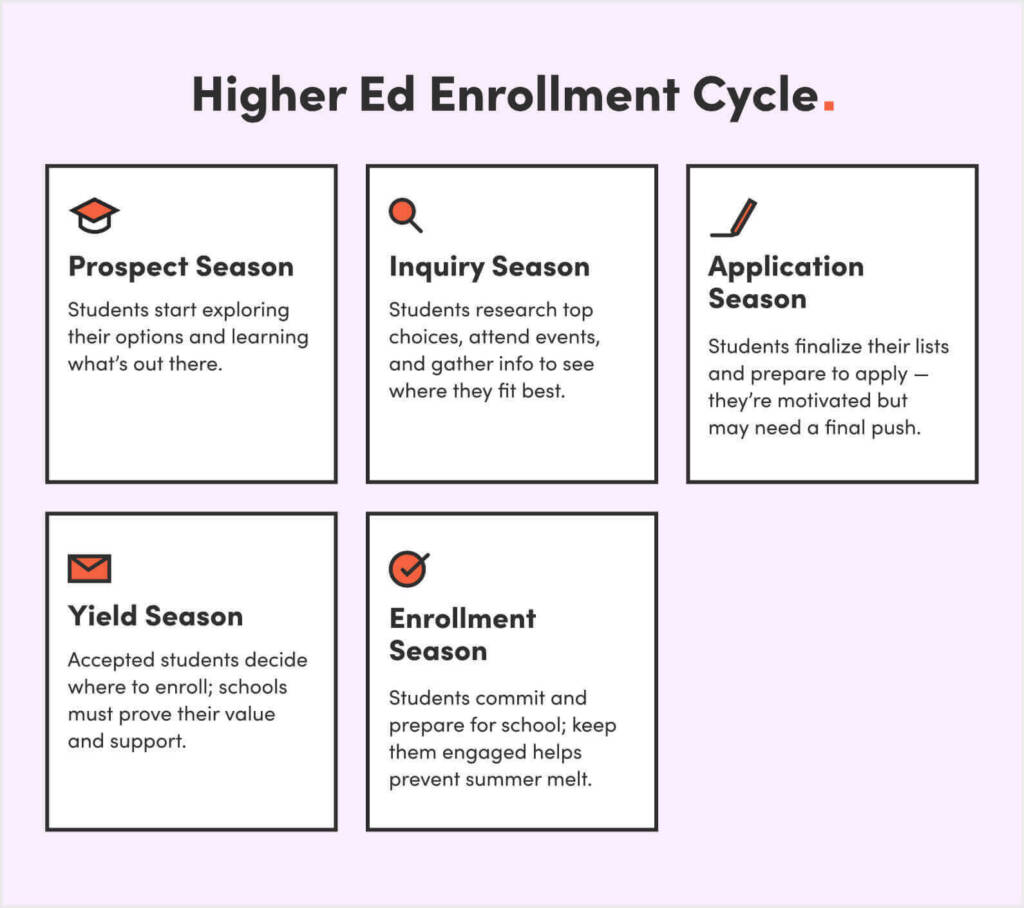
- Prospect Season: This is where prospective students begin their search. They may not have any specific programs or even institutions in mind yet; they’re just trying to get a lay of the land and see what’s available to them.
- Inquiry Season: Prospective students are starting to build out their consideration lists and conduct research into their top contenders. At this stage, they often attend info sessions, request brochures, reach out directly to admissions directors with questions, and consume content about potential programs of study and campus life — anything to get a feel for whether each institution could be a good fit for them.
- Application Season: Serious prospects are compiling their final lists and checking them twice to make sure each institution fully aligns with what they’re looking for before they apply. Prospective students at this stage are often highly motivated and ready to take action but may need an extra nudge to convince them to submit.
- Yield Season: Admissions decisions are out, and it’s up to accepted students to make their final pick. Even now, the competition is fierce, and the institutions most likely to stand out are the ones best able to convince accepted students of their return on investment (ROI) and to provide meaningful support in the form of financial aid.
- Enrollment Season: Deposits and paperwork are in, and most students are gearing up to begin school. Emphasis on most: This is when summer melt is most likely to strike, so universities need to make an additional effort to keep students engaged and excited for the upcoming academic year.
Why does seasonality matter in higher education?
Seasonality is crucial in higher education — particularly enrollment marketing — because:
- It provides structure and predictability for planning. Seasonality gives marketing and admissions teams a shared framework to organize campaigns, budgets, and goals across the academic year. For example, undergraduate teams rely on this cadence to coordinate campus visits, application pushes, and admitted student events, while graduate teams use it to align paid campaigns, content, and lead nurturing around cohort start dates and application deadlines. Without this structure, teams risk doing everything at once instead of executing the right tactics at the right time.
- It aligns marketing messaging with the prospect’s mindset. Each season reflects a different psychological state in the student journey. For example, during yield season, accepted students who have received multiple offers are looking for validation as to which choice is the right one. Personalized outreach is critical here, as is any content demonstrating real-world ROI, such as alumni outcomes. When messaging aligns with where a prospect is in the enrollment cycle, campaigns feel relevant and timely.
- It keeps teams synchronized across the funnel. Seasonality connects marketing and admissions efforts, ensuring that marketing knows when to shift from lead gen to conversion, admissions knows when to ramp up personal outreach, and leadership knows when to expect measurable results.
- It enables data-driven forecasting and goal setting. Each season has distinct key performance indicators (KPIs). Tracking and comparing metrics season over season enables teams to forecast future performance and diagnose problems early.
It also builds momentum and predictability year over year. Because higher ed marketing runs on annual cycles, you can compare performance by season rather than arbitrary months, which enables teams to build institutional memory.
- It directly impacts enrollment and revenue outcomes. Ultimately, enrollment seasonality matters because it drives the business model of higher education. If a program misses its prospect or inquiry season, it also misses out on all the prospective students who might’ve submitted during application season, resulting in lost revenue until the next cycle. Anchoring marketing efforts to defined seasons — including yield season — creates consistent, predictable enrollment pipelines.
How to Measure Yield
Yield refers to the total number of accepted students who actually enroll at a higher ed institution.
It’s a fairly straightforward metric, and calculating your yield rate is just as easy. Simply take the total number of enrolled students for an academic year and divide it by the number of accepted students, then multiply by 100. For example, if your university accepted 1,000 students and 800 of those students enrolled, you’d have a yield rate of 80%.
Yield rates vary widely across institutions, with more prestigious institutions and those with strong brand name recognition achieving higher rates. Harvard, for example, boasts an 85% yield rate for the Class of 2029; though its admit rate is not yet available for the same period, historical data tells us that it tends to be quite small, with the admit rate for the Class of 2028 clocking in at just 3.65%.
Though there are numerous factors that dictate what a “good” yield rate will look like for your institution, Enrollify states that “highly selective universities often see yield rates above 50%, while less selective schools typically range between 20–40%.”
5 challenges universities face during yield season
Yield season is when months of recruitment and relationship-building are put to the test. It’s the most critical (and the most volatile) stretch of the enrollment cycle, marked by shifting emotions, mounting competition, and heightened pressure to deliver on institutional goals.
Understanding the challenges that emerge during this period is the first step toward converting accepted students and sustaining their confidence and commitment through to matriculation:
- The Shift from Aspiration to Evaluation: Throughout the first half of the enrollment cycle, prospective students are picturing what the future might hold for them with rose-colored lenses on. They’re imagining what their life might look like on campus — a vibrant social life, newfound independence, and exposure to thought-provoking ideas — or what their degree might empower them to achieve, such as a high-paying career with opportunities for advancement. It’s all very exciting, and marketing materials often reflect this breathless tone. But yield season is where the rubber meets the road. As those same students shift to evaluation mode, their mood changes from optimism to caution, and they start to ask serious questions such as “Can I actually afford this?” and “Is this the best move for me right now?” This cognitive shift makes it much harder to sustain engagement. After all, your target audience is experiencing decision paralysis and is more than likely feeling risk-averse.
- Disconnection = Disengagement: The tone of outreach also tends to undergo a dramatic shift once admissions are released. Students are no longer courted, but expected, and once-personalized communications become procedural in nature. It’s enough to shake some accepted students’ confidence, opening the door to doubt. If students don’t feel connected to peers, professors, or the campus at this pivotal stage, or if they feel they’re seen as a number rather than an individual, any commitment they make will be tentative and all too easy to walk away from. And once lost, these students are often irrecoverable.
- Competitive Noise Is Deafening: Competition exists at every stage of the enrollment cycle but reaches a fever pitch during yield season, when every institution is sending a flurry of reminders, financial aid notices, orientation invites, and “why choose us” emails within the same 4–6-week window. It can easily overwhelm accepted students and feed into the fatigue they’re facing. And that’s assuming they’re even weighing these messages equally. The truth is, accepted students filter all of this information through the preferences they’ve developed throughout their recruitment journey. If your institution wasn’t already a front-runner, you could be pushed to the periphery. With so many decisions still ahead of them — which financial aid package to choose, which classes to enroll in, whether to live on campus or off, and so on — students often default to the institution that feels most familiar, not necessarily the one with the best pitch.
- Competing Internal Priorities: Yield season coincides with other major events and initiatives for university marketing teams, including commencement, new creative planning, and even summer term launches. Despite yield season being the most critical phase for enrollment revenue, and there being a real need for concentrated, sustained effort, these competing priorities pull teams’ attention in many different directions. The motivation is there, but not always the follow-through, which means universities often leave money on the table.
- Summer Melt: If there’s one thing every higher ed professional learns early on in their career, it’s that a deposit isn’t a guarantee. There are plenty of accepted students who commit to a university and put down an initial deposit but never show up for classes. While this phenomenon — known as “summer melt” — is more common amongst undergraduate students, it can just as easily impact graduate degree and online programs. It’s difficult to attribute summer melt to just one cause. Instead, it’s often due to a combination of factors, including emotional detachment, changes in circumstances, financial or logistical friction, competing interests, and a breakdown in institutional handoffs. Whatever the cause, the end result is the same: lost enrollees, and lost revenue.
9 ways universities can engage prospective students during yield season
During yield season, the students you’ve accepted are excited but uncertain, weighing offers, waiting on financial aid, and imagining what life on campus might really look like. To keep them locked in, you need to engage these students with intentional, high-touch strategies that reinforce belonging, clarify next steps, and keep the emotional connection alive right up to the first day of classes.
- Personalize your messaging to reinforce commitment. The first step to keeping accepted students engaged is to continue to court them with personalized communications that speak directly to their interests, priorities, and areas of concern. Is the student moving across the country to attend your institution? Send them an email that connects them with a current student from the same area who can offer tips to help them adjust to their new setting. Did the student apply to a particular academic program? Send them a brief video from that program’s director welcoming them and letting them know what to expect. Did the student apply for financial aid? Reach out to connect them with an academic advisor who can answer any questions they might have and guide them through the process.
There’s really no limit to the ways in which you can make accepted students feel seen, heard, and valued at this critical stage. So long as you continue to treat them as individuals who truly matter, you’re well on your way to reducing the risk of last-minute melt.
- Create a sense of community. The science doesn’t lie: Humans feel a fundamental need to belong, and appealing to that need is a powerful, persuasive tool. You can use this to your university’s advantage during yield season by building exclusive online communities where accepted students can connect with their soon-to-be classmates, sending out lists of upcoming on-campus events tailored to their particular interests, and creating guides that let students know what to expect from their first week at school.
User-generated content (UGC) goes a long way here — think “Day in the Life” vlogs from current students; TikToks and Reels showing dorm room makeovers; playlist exchanges through Spotify or Apple Music; and student-run Q&A sessions on Reddit, Discord, or Instagram Stories. The ultimate goal here is to depict your university as a vibrant place where accepted students can find their community, form meaningful relationships, and have exciting experiences they couldn’t have anywhere else. - Maintain momentum. There’s nothing quite like the adrenaline rush applicants experience when they receive their acceptance letter — it is, after all, the culmination of so many years of hard work, careful research, and countless applications. But that enthusiasm can fade during the months between acceptance and enrollment as reality starts to set in.
As university marketers, it’s your job to maintain this momentum with curated content, such as “Countdown to Campus” materials featuring campus traditions, events, and peer stories, and messaging that reinforces the ROI of enrolling at your institution. Don’t forget to include accepted students’ families. Whether it’s an undergraduate’s parents or a grad student’s partner, their family will likely play a pivotal role in their decision, so CC relevant parties to organically sustain energy and excitement.
Last, though certainly not least, try to create urgency without adding pressure. Displaying countdown clocks and enrollment deadlines across all channels can light a fire underneath students to complete paperwork and make deposits. You can even sweeten the deal by offering incentives for early commitment. For example, Northeastern University has an entire page dedicated to the benefits of early decision, including an application fee waiver, early need-based financial aid review, and accelerated scholarship eligibility.
- Make the value proposition feel real. Speaking of ROI, now’s the time to be specific. Abstract claims such as “world-class faculty,” “small class sizes,” and “strong outcomes” fall flat compared to verified statements such as “ranked among the top 10 universities in the U.S. for best professors,” “10:1 student-to-faculty ratio,” and “95% employment post-graduation.” Be sure to make this information a focal point of your yield season marketing materials with eye-catching graphics.
If you can secure social proof in the form of success and testimonials from current students and alumni — especially in video format — so much the better. The more you can demonstrate that your institution delivers measurable results that contribute to students’ lifelong success, the more you can reduce their anxiety and reaffirm their investment. - Reduce friction in the onboarding process. As complicated as the application process can be, it pales in comparison to new student onboarding. From filling out financial aid paperwork and registering for orientation to selecting classes and coordinating move-in, there are a lot of moving parts and pieces for accepted students and their families to manage. The more overwhelmed they feel, the more appealing it is for them to take a gap year or pursue other, less intimidating prospects. To cut back on administrative complexity, consolidate all enrollment steps into a single, mobile-friendly portal, explain each step of the process in easy-to-understand language, and automate email- or SMS-based reminders to keep students on track. Little affirmations such as “You’re one step closer!” paired with reminders about what awaits them at the end of their journey — thought-provoking classes, a thriving social scene, leadership opportunities, and more — can go a long way toward motivating students to complete their onboarding. And don’t forget to provide real-time chat or texting support (with actual enrollment professionals) to help them troubleshoot any issues they encounter.
- Build family confidence. We mentioned earlier that students’ families often have a lot of sway over their decision to enroll. Use that to your advantage by creating content that speaks directly to this segment. Family-specific newsletters and webinars can address key topics such as safety, affordability, and student support, while downloadable guides can offer practical steps to help families navigate the logistics of financial timelines, moving, and orientation.
- Keep everyone on the same page. Institutional silos can rear their ugly heads during yield season, causing accepted students to receive conflicting information from admissions, housing, financial aid, and more. This confusion can breed distrust during one of the most pivotal moments of a student’s journey and send them into the arms of your competitors — or push them to think higher ed might not be for them, after all. Don’t introduce unnecessary risk. In the lead-up to yield season, create a unified content calendar across all departments and develop content that is consistent in design and tone. Perhaps most importantly, designate a single point of contact (POC) to manage all post-admission queries and list them as the sender on all communications. Even if multiple departments weigh in to provide answers to students’ questions, having a single POC streamlines communications and makes it easier for students to keep track of critical information and ask follow-up questions as needed.
- Maintain a presence across digital touchpoints. When faced with such a major decision, smart students do their homework. That means browsing competitors’ sites and social media to soak up every piece of information they can and looking for firsthand accounts from fellow students about their experiences.
We’ve already touched on the value of UGC and alumni testimonials, but remaining top of mind requires a coordinated effort that includes: - Paid media: Yield-specific retargeting campaigns that run from admissions decision through the deposit deadline with creative tailored to the post-acceptance mindset
- Organic social media: Community-oriented content and direct engagement across platforms such as TikTok, Instagram, and X
- Email and SMS: Communications that reinforce your brand narrative, prompt action with reminders around key milestones, and drive engagement across other digital assets with embedded social content and cross-channel CTAs
- Video: Short-form videos on TikTok, Reels, and YouTube Shorts and YouTube playlists for accepted students with videos covering topics such as “Life in [City Name]” or “What You Need to Know About Financial Aid” (check out Arizona State University’s “FAFSA Bootcamp” series for a great example of this!)
- Search and SEO: Branded and near-branded search campaigns that capture late-stage research behavior, paired with optimized accepted student and campus life pages aligned to post-acceptance intent Persistence is key here, as is consistency in your brand messaging. You’ll also want to integrate your customer relationship management (CRM) audience data with ad platforms and set up behavioral retargeting triggers to ensure students see consistent, contextual content that drives them one step closer to choosing your institution.
- Closely monitor engagement. The warning signs of melt can be subtle — a couple unopened emails or a week’s worth of student portal account inactivity — and too easily overlooked. That’s why early detection is critical. You can set up CRM dashboards to track open and click behavior, form completion, account activity, and event attendance, and flag low-engagement students for personalized outreach by counselors or student ambassadors. By keeping tabs on accepted students and providing them with support and guidance through the final stages of their enrollment journey, you can help them feel confident and connected — and secure your institution’s position at the top of their list.
Yield season might feel like the end of the road, but it’s really the final stretch of the race. With the right mix of marketing strategy, authenticity, and timing, you can turn accepted students into committed ones and close the loop on all the hard work that came before.
Ready to make this yield season your strongest yet? Contact the team at Vital! We’ll help you build a yield season strategy that keeps accepted students excited, engaged, and eager to say “yes.”