LinkedIn is one of the most important places for law schools to compete for attention. But, if you’ve spent any time scrolling through sponsored posts, you know a lot of programs start to blend together. So, we decided to dig deeper.
We analyzed 45 LinkedIn ad campaigns from top U.S. law schools to understand how these programs position themselves, which patterns are emerging across the industry, and which opportunities they’ve missed. The goal isn’t to critique individual schools, but to give you a clearer picture of what’s happening so you can make smarter, more strategic decisions with your own campaigns.
Want to cross-reference as you read? Download the full dataset here to see the numbers for yourself.
Law School LinkedIn Ad Campaign Quick Hits
Only have a few minutes to spare? No worries — we’ve rounded up the highlights from our study:
- 62% of ads use “Learn more” as their primary CTA.
- 22% of ads don’t include a primary CTA.
- 56% of ads use clearly identifiable stock photography.
- Two-thirds of ads (67%) include one or more people in their featured image.
- 3 out of 45 ads (7%) incorporate video.
- 10 out of 45 ads (22%) feature social proof.
- The most common value propositions were fast completion (7%), part-time programs (7%), flexible pacing (17%), and online format (33%).
- 82% of ads frame some form of flexibility as a competitive differentiator.
- Just 1 ad (2%) used a multi-image format.
- 3 out of 45 ads (7%) explicitly state their program is designed for non-lawyers.
- 6 out of 45 ads (13%) position schools as “nationally ranked” or “top ranked”…
- …But only 3 of those 6 (7%) support those claims with a specific source.
Now, onto our findings.
1. Soft CTAs Limit Conversion Opportunities
“Learn More” seems to be the default for higher ed advertising, with 62% of law school LinkedIn ad campaigns using it as their primary call-to-action (CTA). It’s low commitment, easily understood, and broad enough to appeal to a range of funnel stages. But, in this dataset, the near-universal reliance on “Learn More” suggests a lack of segmentation and strategy, not just preference.

When three out of five ads use the same vague prompt, it becomes difficult for any single ad to stand out. Worse, the absence of a primary CTA in 22% of ads indicates some institutions are overlooking even the most basic principles of ad conversion.
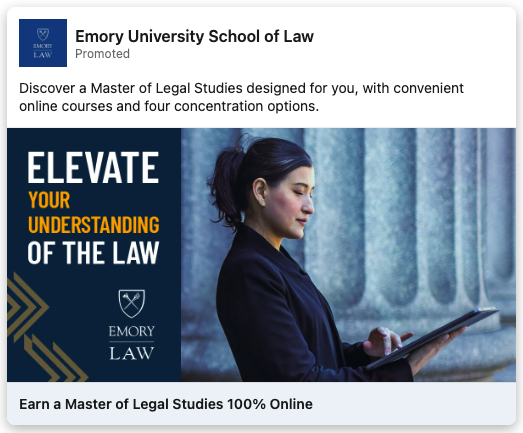
This matters because prospective law students, especially those in later stages of decision-making, need clarity, not ambiguity. A prospect who has already researched several programs doesn’t need to “learn more,” they need to know what happens next. Can they apply now? Talk to someone? Compare tracks? CTAs are signals of readiness. When a law school doesn’t reflect urgency or action in its LinkedIn ad campaign strategy, it risks missing out on its most qualified prospects.
Institutions should adopt a tiered CTA strategy mapped to the funnel stage and campaign objective. Top-of-funnel awareness ads can lean on “Learn More,” but middle- and bottom-of-funnel retargeting campaigns should test CTAs such as:
- “Start Your Application”
- “Talk to Admissions”
- “Download Our Program Guide”
At bare minimum, every ad should include some kind of CTA to anchor the next step and reduce cognitive load.
2. Credibility Slips When Creative Leans on Stock
Stock images are everywhere — 56% of the ads we reviewed included clearly identifiable stock photography. The widespread use of stock imagery in LinkedIn ad campaigns is understandable, because it’s fast and inexpensive. But it’s also a shortcut that can erode credibility in a category built on trust. Prospective law students want to picture themselves in your program, not in a generic office setting or a smiling businessperson tableau.
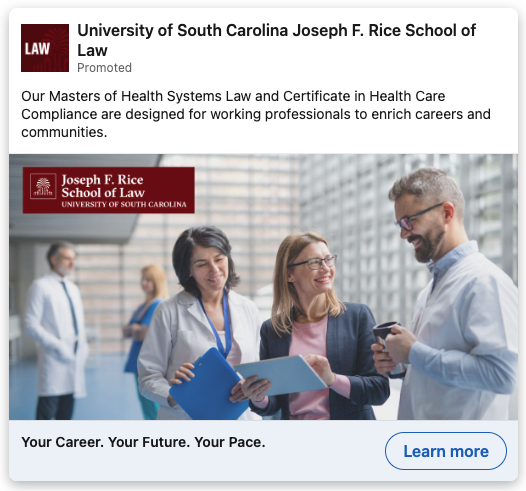
This is a conversion rate issue. Stock photos (and videos) may pass brand compliance, but they don’t convey campus culture or student identity. In legal education, where the stakes are high and decision cycles are long, a stock-heavy visual strategy sends the wrong message.
Institutions should audit their creative library and prioritize original visuals, especially for student spotlights, faculty features, and real classroom environments. Crowdsourcing authentic photos from students or repurposing images from past events can be a smart and scrappy way to replace generic visuals without blowing your budget.
Is your program online-only? No problem. You can still use images of actual students and faculty members to establish credibility with prospects.
3. Ads Rely on Faces — And That’s a Good Start
Two-thirds (67%) of the ads we reviewed include one or more people in their featured image. In an attention economy dominated by scrolling, faces still stop thumbs.
Neuroscience tells us humans are instinctively drawn to faces — so much so that we even “see” faces in inanimate objects, a phenomenon known as pareidolia. This is to advertisers’ advantage. A 2018 study found that 91.7% of ads that feature a person’s face attract more attention than ads without faces. Later studies confirm this: User-generated videos with moderate face presence yield the highest levels of engagement.
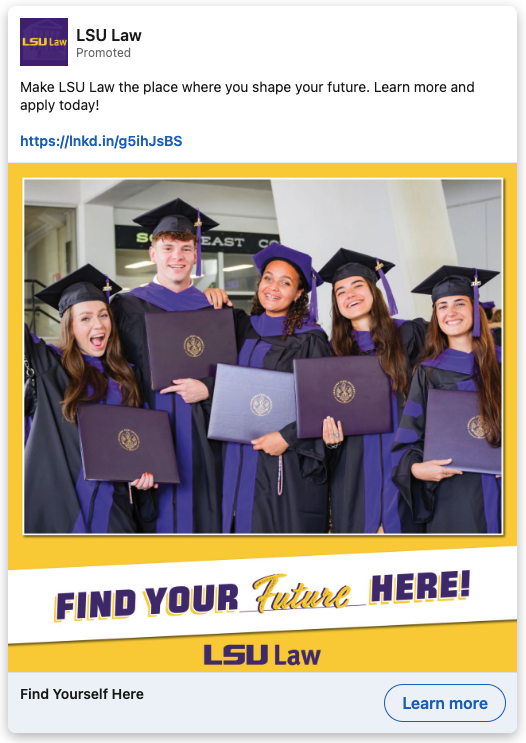
Based on this data, it’s encouraging to see so many ads featuring either individuals or small groups (typically students, faculty, or professionals). These visuals help drive engagement, especially when subjects were photographed authentically and in context.
With that said, the real opportunity lies not just in featuring people, but in using them to tell a story. Few of the ads that feature faces include a name, quote, or hint of a narrative. It’s one thing to see a student in a suit; it’s another to know she’s a mom who earned her MSL online while working a full-time job.
This ties back to using images of actual students and faculty instead of stock images. For example, including a photo of a recent alum alongside their testimonial delivers a powerful one-two punch, capturing prospects’ attention while conveying the value of your program in a former student’s own words. At the end of the day, story-rich visuals build affinity and aspiration.
4. Video Remains a Missed Opportunity
Just 3 out of 45 (7%) of the law school LinkedIn ads we reviewed use video.
That’s a surprisingly low number in a feed dominated by movement, audio, and narrative. On LinkedIn, video content generates more engagement than static creative, especially when designed with mobile-first behavior in mind. Law schools have rich stories to tell about student journeys, faculty achievements, and alumni outcomes. Videos should be the format of choice for conveying these multi-dimensional experiences.
The issue often stems from perceived production barriers but, in practice, video doesn’t have to mean high-end shoots. It can be:
- Lo-fi, selfie-style student testimonials
- Motion graphics animating program benefits or outcomes
- Faculty interviews shot on Zoom and edited for brevity
Done right, even scrappy video content can outperform polished static ads, so long as it’s relevant and resonant.
5. Social Proof Is the Exception, Not the Rule
Only 10 out of 45 ads feature any form of social proof, which is surprising given how central credibility is in legal education marketing.
Whether it’s a national ranking, a testimonial from a successful alum, or a stat about bar passage rates, social proof signals quality and reduces risk. External validation can make or break a conversion, especially for non-JD programs targeting career switchers or international applications, yet the vast majority of LinkedIn ad campaigns neglect to include it. That’s a missed opportunity for both persuasion and differentiation; rankings and testimonials can help lesser-known institutions stand out against big-name competitors.
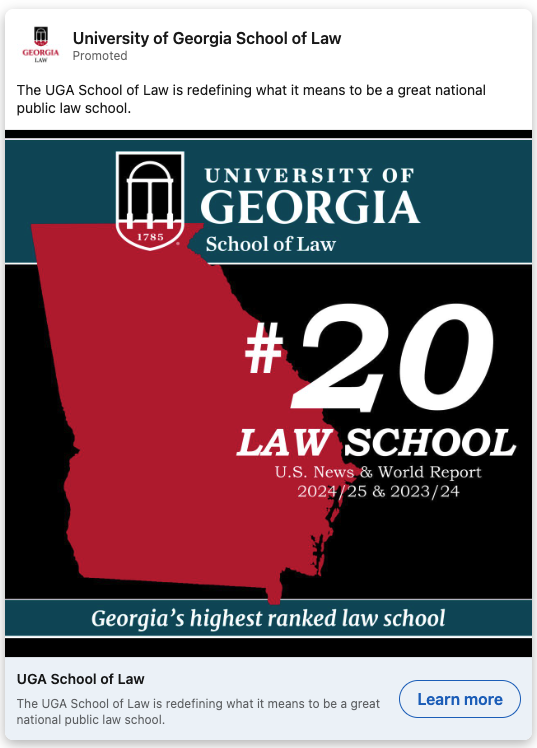
Here are some standout examples from the 22% of ads that did include social proof:
- “#20 Law School – U.S. News & World Report 2025/25 & 2023/24” (University of Georgia School of Law)
- “#24 Best Salary to Debt Ratio – U.S. News & World Report” (University of Houston Law Center)
- “Top 10 LLM Programs for U.S. Tax Law – LLM Guide” (University of San Diego School of Law)
- “Ranked as one of the most affordable law schools – preLaw Magazine” (William S. Boyd School of Law, University of Nevada-Las Vegas)
Whether qualitative or quantitative, proof points move the needle, so use them early and often.
6. Flexibility Isn’t the Flex It Used to Be
The most common value propositions we saw across all of the ads we reviewed were: fast completion (7%), part-time program (7%), flexible pacing (17%), and online format (33%). While these figures might seem low and not particularly noteworthy, consider this: These are all just different ways of conveying that each program offers flexibility. When you look at it that way, the numbers paint a more interesting picture, with 82% of programs framing some form of flexibility as a competitive differentiator.
While this flexibility is great — and necessary — it’s also pretty expected. When every institution starts saying the same thing, it no longer stands out.
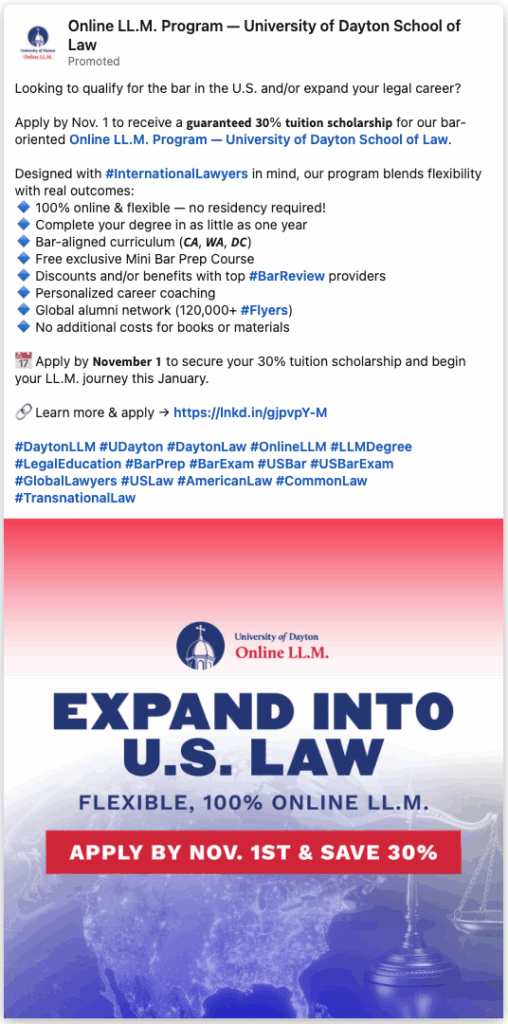
When marketing to working professionals, you still need to highlight convenience and format, but don’t stop there. What will students gain from earning this degree? What’s your track record on helping students change careers, level up, or lead in new sectors? Try shifting from features to outcomes. It’s not just that your program is online; it’s that students graduate with the credibility, credentials, and network to take on more rewarding, higher-paying roles.
7. Too Many Ads Play to the Wrong Stage of the Funnel
Despite the variety of ad placements and likely audience segments, many of these ads feel like top-of-funnel plays, with non-descriptive CTAs, generic headlines, and little-to-no urgency. If you’re running retargeting campaigns to past site visitors, email subscribers, or CRM lists and still serving them intro-level messaging, you aren’t helping them move forward. You’re just repeating yourself.
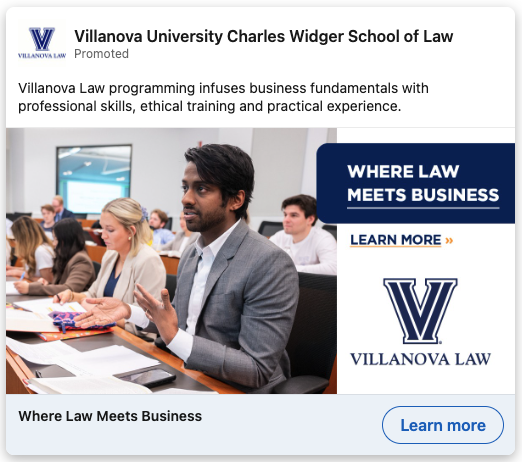
Your LinkedIn ad campaign strategy should map to your audience’s familiarity with your program. Top-of-funnel ads? Lean into curiosity and brand-building. Mid-funnel? Offer info that will help prospects self-compare. Bottom-of-funnel? Make the next step feel obvious. For example:
- “Download the Program Guide” for early stage researchers
- “Start Your Application” for retargeted visitors
- “Talk to Admissions” for those who’ve started to fill out a form but haven’t submitted
LinkedIn makes this degree of granular segmentation possible, so put it to good use.
8. Multi-Image Formats Are Rare
Despite their versatility, only one institution — the University of Pennsylvania Carew Law School — included in our study used a multi-image format. Other institutions missed a real opportunity to showcase different aspects of your institution or even a specific program.
While Carey School of Law successfully uses this format to highlight its different degree tracks, that’s just one example. You could also use a multi-image format or carousel ad to demonstrate a typical student journey — meet our students, take a look inside the classroom, see where our graduates go, choose your path, and take the next step — or to spotlight a specific student and let them tell their story.
Ultimately, this is a format made for exploration — and when you’re selling something as complex as a legal degree, it pays to break your message into digestible, visual steps.
Moral of the story? Don’t just push one hero image. Let people swipe through the story.
9. Programs for Non-Lawyers Are Emerging, But Still Underrepresented
Only 3 of the 45 ads (7%) included in our study explicitly stated that their program was designed for non-lawyers. That’s surprising, given how quickly demand for MSL, MJ, and other non-JD offerings has grown in recent years. These programs offer exactly what mid-career professionals are searching for: legal grounding without the three-year investment of a JD. But if only a handful of schools are calling out to this audience directly, most are missing a chance to speak to a fast-growing segment.

Prospects can’t choose a category they don’t know exists. If they don’t realize that there are law-adjacent degrees built for them, they’ll assume law school is off the table entirely. If your institution offers a program designed for non-lawyers, say so. Use headlines that directly acknowledge this audience, clarify career outcomes tied to non-lawyer degrees, and explain how the program specifically caters to mid-career students.
10. Ranking Claims Fall Short Without Named Sources
Six schools in our LinkedIn ad campaigns review positioned themselves as “nationally ranked” or “top ranked,” but only half of them supported those claims with a specific source. This isn’t an issue of legality, but one of credibility. Graduate-level students, especially those considering high-investment programs such as a law degree, look for third-party validation. Saying you’re “top ranked” without naming which organization said so forces prospects to take your word for it, and most won’t (especially future lawyers).
More importantly, unsupported ranking claims put institutions at a disadvantage next to those that do name their sources. “Nationally ranked” sounds generic. “Ranked as one of the most affordable law schools by preLaw Magazine” feels real.
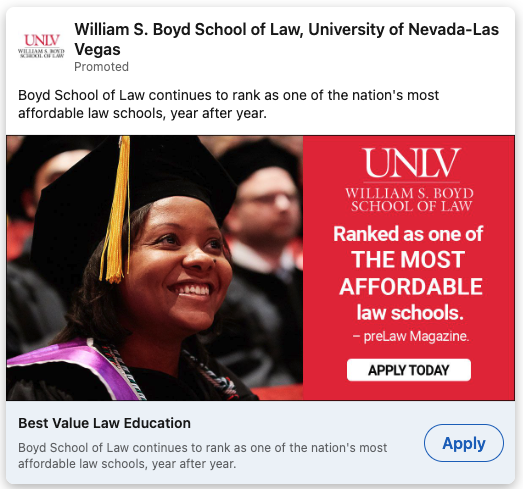
This data point also tells us something broader. Institutions already understand that rankings matter, they just aren’t maximizing the impact. With a simple shift to citation-backed claims, they could strengthen and differentiate themselves more effectively.
Some easy wins:
- Reference the awarding body directly, even if the placement is modest.
- Consider using recognition beyond traditional rankings.
- Pair proof with outcomes to avoid sounding boastful.
16 Best Practices for More Successful LinkedIn Ad Campaigns
Make sure to apply these best practices from our study — and beyond — when you start to build your next LinkedIn ad campaign:
- Match your CTA to the prospect’s stage. Use lower-commitment CTAs for awareness and stronger, more specific CTAs for retargeting. Above all, make sure every ad gives a clear next step.
- Build an authentic visual library. Invest in photos and videos that reflect real students, faculty, and spaces. Authentic visuals consistently outperform generic stock.
- Let your visuals do more than decorate. Use imagery that adds meaning — if you’re talking about online or part-time formats, show students studying between work and family commitments. If you’re promoting a specialized track, show contexts related to that field.
- Incorporate motion where possible. Short clips, animated stat callouts, or simple talking-head testimonials from students, faculty, and alumni can help your ads stand out in text-heavy LinkedIn feeds.
- Bring credibility forward. If you highlight rankings, awards, or recognitions, name your sources. Specific, verifiable social proof builds trust in a highly competitive space.
- Anchor claims in outcomes. Prospects want to understand what they’ll gain from your program, whether that’s career mobility, specialization, deeper legal fluency without a JD, or something else entirely. Let outcomes — not format details — guide your messaging.
- Use a mix of ad formats to tell your story. Carousels can highlight specializations, faculty strengths, or career paths. Single images work well for quick-hit messaging. Short-form video can deepen connection.
- Segment creative by program type. JD, LLM, and MSL students have completely different motivations. Serve each segment tailored visuals, examples, and outcomes rather than making one creative concept stretch across all programs.
- Clearly identify programs designed for non-lawyers. Many prospects don’t realize law-adjacent degrees exist or who they’re for. Spell it out so they can self-identify quickly.
- Qualify prospects before they click. With LinkedIn’s audience layering capabilities, use parameters such as job titles, industries, seniority, and fields of study to filter out low intent audiences. This will keep your cost-per-click under control while helping your ads reach people who actually resemble your strongest applicants.
- Keep copy concise and conversational. Law is serious, but your ads don’t need to be stiff. Short sentences and plain-language explanations help prospects grasp value quickly while scanning their feeds.
- Build campaigns around enrollment cycles. Law prospects are deadline driven. Structure your creative themes and CTAs around application milestones, scholarship deadlines, and upcoming cohort start dates so your ads feel timely rather than generic.
- Match your ads to your landing pages. If your ad highlights a program for non-lawyers, its corresponding landing page should immediately reinforce that idea. If your ad emphasizes flexible pacing, the landing page should show how that works. Aligning your messaging will build trust and improve conversion rates.
- Use first-party signals to guide retargeting. Retarget prospects who visited key pages such as a curriculum, faculty, tuition, and outcomes. Their browsing behavior gives you clues about where they are in the decision process, and what message will resonate next.
- Translate academic strengths into employer relevance. Law students at every level care about where your graduates end up. If you have strong industry ties, clinic experiences, externships, or employer relationships, bake those narratives into your ads. LinkedIn is an employment-minded platform, so career clarity lands well here.
- Treat every ad as a positioning test. Instead of assuming you know what value prop matters most, use your ad sets to test which messages attract the right prospects, and let performance data tell you what people respond to most strongly.
If you want your LinkedIn ads to work harder, you don’t have to figure it out alone. Vital builds high-performing LinkedIn ad campaigns for law schools and other higher ed institutions across the country, and we’re ready to put that experience to work for you.
Ready to get started? So are we. Let’s talk.