For universities marketing to prospective graduate students, LinkedIn is a critical paid advertising channel. To understand how top institutions are using it, we analyzed 50 LinkedIn ad campaigns for graduate programs across the U.S. This report blends real data from those campaigns with our broader experience running pay-per-click marketing for universities.
Use this analysis to learn how to fine-tune your LinkedIn ads to improve engagement and conversion among prospective graduate students.
Want to take a look at the data yourself? Here it is!
Quick Hits: LinkedIn Ad Trends for Graduate Programs
Here’s a quick summary of what we found across 50 graduate program LinkedIn ad campaigns.
- 52% of ads rely on stock imagery, creating a clear opportunity for schools to use real students and faculty.
- 62% of ads use static photography, while only 12% use video, despite video’s growing impact on LinkedIn.
- Only 28% of ads include any social proof (rankings, accreditation, outcomes, or testimonials).
- 70%+ of CTAs are high-funnel (“Learn More,” “Explore”), with few pushing mid- or lower-intent actions.
- Individual-focused imagery is the most common and effective, outperforming group and campus-only visuals.
- Top-performing campaigns use multi-format, multi-touch strategies, not single creative executions.
Why LinkedIn Ads Matter for Graduate Programs
Graduate prospects act and think differently from traditional undergraduates. They are more likely to be:
- Working professionals
- Career changers
- People with family and financial responsibilities
- Employees responding (directly or indirectly) to employer expectations
That makes LinkedIn uniquely powerful.
- You can target by job title, industry, skills, and seniority
- You’re reaching people in a work mindset, often already thinking about advancement
- You can align messaging directly with career outcomes, not just “student life”
A platform built around professional identity makes LinkedIn a natural fit for graduate program advertising. Targeting by job title, skills, industry, and seniority gives enrollment teams unmatched reach into career-driven segments.
When schools invest in multi-layered, career-forward messaging, LinkedIn often becomes one of their highest-quality lead sources. This is especially true when paired with university paid ad landing pages that align with your ads and follow best practices for keeping prospects engaged and informed.
5 Lessons We Learned from Analyzing 50 LinkedIn Ad Campaigns for Graduate Schools
1. Stock Images Still Dominate (But That’s a Big Opportunity)
From the 50 LinkedIn graduate ads we reviewed:
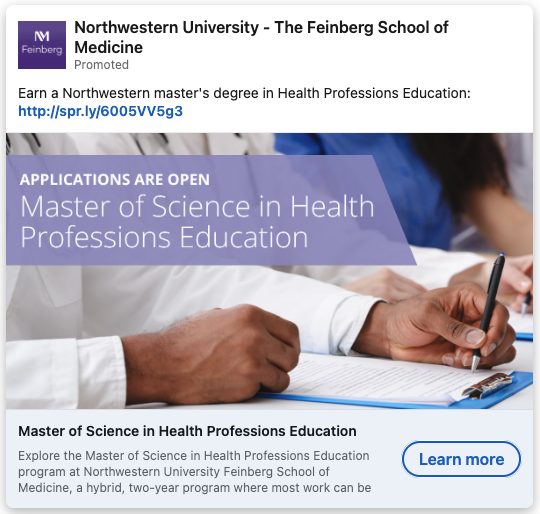
- 52% (26 ads) clearly used stock imagery
- 38% (19 ads) used imagery that did not appear to be stock
- The remaining ads either weren’t clear, or didn’t use photography
This is on par with what we see across higher ed advertising in general. It’s still very common for campaigns to lean on generic professional stock images. Paid ads are filled with smiling people with laptops, ambiguous office environments, and “business handshake” cliches.
Why this matters:
On a platform where users are saturated with stock imagery, authentic creative execution is one of the easiest ways to stand out. Consider investing in photos of:
- Actual students
- Real faculty
- Recognizable campus spaces
- Labs, clinics, or industry-aligned environments
This approach will immediately make your ads feel more specific and credible than those using stock images.
If you must use stock images, consider using a branded treatment to make your ads stand out from the crowd.
Takeaway for your campaigns:
If your LinkedIn ad campaigns are heavily stock-based, you have an easy win: swap in real photography and watch engagement and click-through rate improve.
2. Photography Rules, Video Is Underused

When we categorized the image type used in each ad, here’s how it broke down across all 50:
- Photograph: 31 ads
- Video: 6 ads
- Abstract Graphic: 4 ads
- Illustration: 4 ads
- Other: 1 ad
That means:
- 62% of all ads used photography
- Only 12% used video
- Roughly 18% used abstract, illustrated, or other visual treatments
What we see in practice:
Photography is still the workhorse of LinkedIn advertising for graduate schools — and there’s nothing wrong with that. On LinkedIn, a clean, well-composed image combined with a tight headline can absolutely perform.
But the low video usage is a missed opportunity, especially when:
- Short vertical or square video is now standard
- Many universities already have video assets from organic channels
- Video is ideal for telling quick, emotional stories or spotlighting faculty/alumni
How to create a LinkedIn ad campaign that uses visuals effectively:
- Build a base set of high-quality photo ads (your evergreen workhorse)
- Add short video units (10–20 seconds) featuring real people, such as students, alumni, and faculty
- Test abstract or illustrative creative for specialized programs (data science, AI, cybersecurity, etc.), where conceptual visuals can help
3. Social Proof Is Rare — Which Is Great News for You
One of our most striking findings was that very few graduate LinkedIn ads leveraged social proof or validation.
Out of 50 ads:
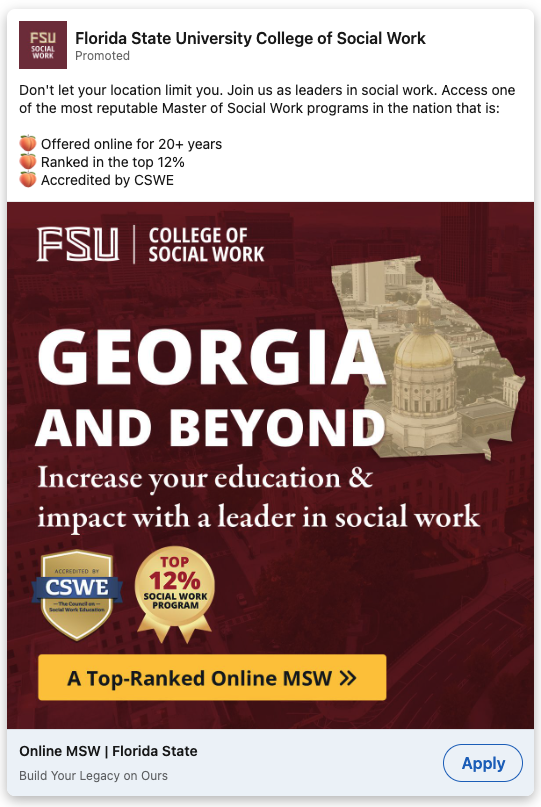
- Only 14 clearly included any form of social proof, such as:
- Rankings (e.g., “Top 10,” “Top 25” nationally)
- Accreditation callouts
- Awards
- Testimonials or success stories
- Employer logos or outcomes
- Average salary information
- 35 ads explicitly contained no social proof
- 1 was ambiguous
That’s only about 28% of ads using social proof at all. An even smaller percentage of 15%–20% are using it in a strong, front-and-center way.
Why this is a huge opportunity:
On a platform built around professional credibility, not leveraging proof points is a major miss. You can set your campaigns apart just by including:
- Rankings (“Top 10 Online MBA in the Northeast”)
- Accreditor names (AACSB, CEPH, ABET, CSWE, etc.)
- Outcomes (“Join graduates working at [Employer names or logos]”
- Short testimonial quotes (“This program helped me move into a leadership role in healthcare.”)
How to run a LinkedIn ad campaign that builds trust:
- Incorporate one proof point into every ad set: ranking, accreditation, or outcomes.
- Use design elements (badges, callouts) to make validation stand out visually.
- Test one version of your best-performing ads with proof and one without. You’ll likely see a lift in CTR and lead quality.
4. CTAs Lean Heavily on High-Funnel Intent
The dataset shows a wide variety of CTA labels, but the dominant patterns all point to high-funnel actions, such as:
- “Learn More”
- “Explore the Program”
- “Visit Website”
Far fewer ads used bottom- or mid-funnel CTAs like:
- “Request Info”
- “Download Program Guide”
- “Register for an Info Session”
- “Start Your Application”
Why that matters:
“Learn More” is easy, flexible, and safe, but because it’s vague, it often underperforms. For graduate prospects who are already on LinkedIn, in a professional context, and reading a targeted message about a specific degree, you can usually afford to be more specific.
How to improve your CTAs:
Instead of “Learn more,” try intent-specific CTAs such asL
- “Download the Program Guide”
- “Get Info on Tuition & Deadlines”
- “See Curriculum & Course List”
- “Talk to an Enrollment Advisor”
These CTAs do a better job of framing what happens next and attracting prospects who are genuinely ready to engage.
5. Imagery Framing: Individuals Lead the Way
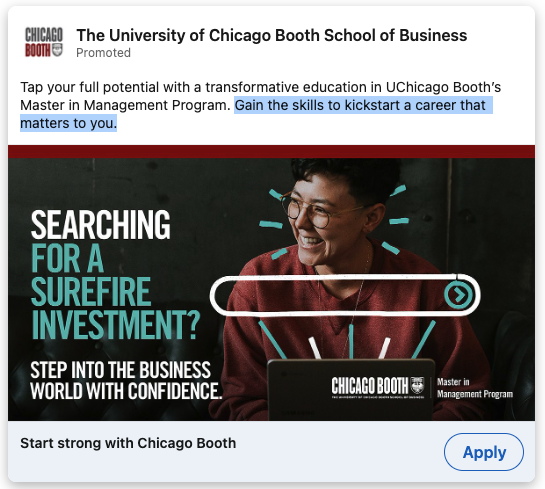
When we looked at the primary subject framing (what’s actually in the ad images), we saw a large variety of descriptions, but some clear themes:
Most common:
- Individuals (students or professionals)
- Groups (classroom or collaboration shots)
- Campus or building exteriors
- Abstract / tech-centered visuals
This aligns with what we see performing well in higher ed LinkedIn ads:
- Individual-centric imagery works well for personal connection
- Groups and classroom scenes can reinforce community and collaboration
- Buildings and campus shots are less differentiating but can reinforce brand identity
- Abstract tech graphics align well with STEM, analytics, AI, and engineering programs
Practical recommendation:
- Prioritize individual student or alumni imagery for most programs
- Use abstract or conceptual visuals for data-heavy or highly technical degrees
- Avoid generic “business stock” whenever possible — your audience has seen it a thousand times this week alone
- Vary your image subjects to avoid ad fatigue and to mirror your enrollment pool.
How to Create a LinkedIn Ad Campaign for Your Graduate Programs (Based on Our Study)
Pulling everything together, here’s a simple framework for how to create a LinkedIn ad campaign for graduate programs that’s grounded in the data and our experience:
1. Start with Clear, Audience-Focused Positioning
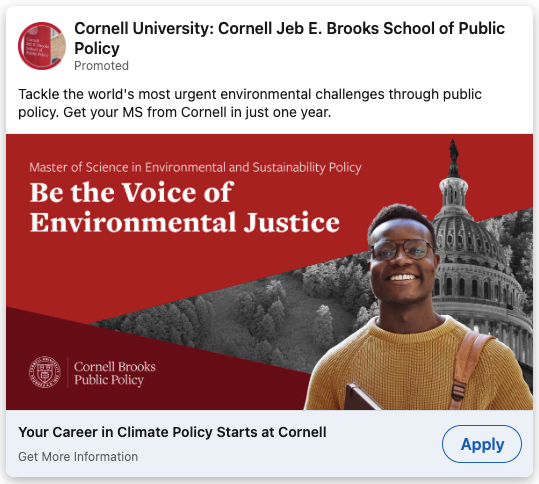
Lead with benefit-focused language such as:
- Career outcomes (“Advance into a clinical leadership role”)
- Skill gains (“Build in-demand analytics skills”)
- Employer-aligned value (“Designed with input from industry leaders”)
Avoid opening with internal-focused language like “Our renowned faculty…” Your goal is to get prospects to take the next step, and if you succeed, you’ll have plenty of opportunities to tell them more.
Pro-tip: Knowing your audience is key here. Building detailed personas that define the prospective students you’re trying to attract will help you refine your messaging and positioning for the greatest impact. For example, if your university is struggling with a decline in international enrollment, invest in messaging strategies that focus on domestic student value drivers.
2. Use Real Photography as Your Baseline, Then Layer in Video
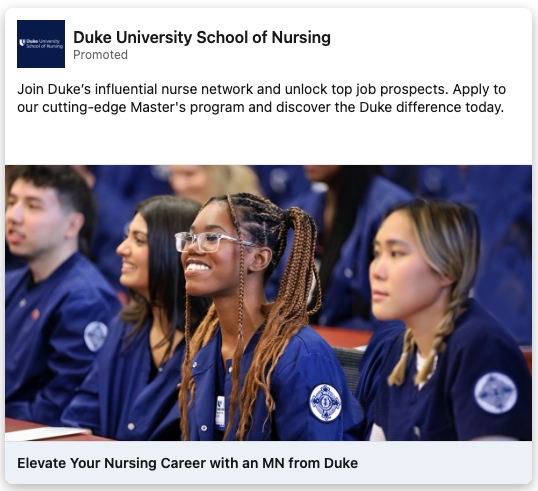
According to the data, photos are everywhere, and video is not.
- Build photo-based ads with real students, alumni, or faculty
- Add short, captioned video ads that tell one story per asset
- Test abstract or illustrative creative where it fits the program personality
3. Make Social Proof Non-Negotiable
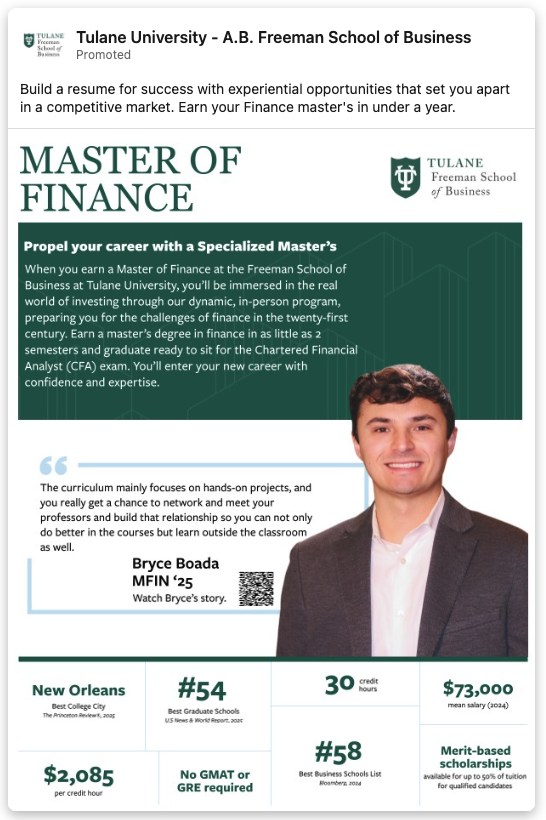
Since most schools skip it, you can stand out by:
- Calling out rankings or recognition
- Featuring respected accreditation
- Highlighting employer outcomes
- Using short, specific testimonials
Even one line of proof can dramatically increase perceived credibility.
4. Match CTAs to Funnel Stage
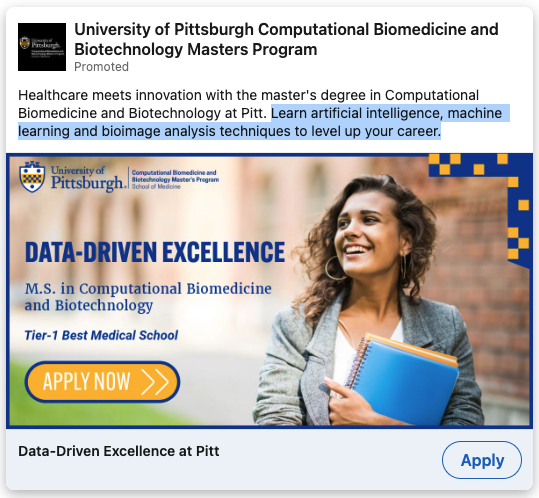
For prospecting audiences:
- “Download the Program Guide”
- “See Curriculum & Outcomes”
For retargeting audiences:
- “Apply”
- “Register for an Info Session”
- “Talk to an Enrollment Advisor”
- “Start Your Application”
5. Build a Multi-Touch, Always-On System
The strongest performers don’t treat LinkedIn as a one-off campaign. They:
- Run always-on awareness and lead gen campaigns
- Layer remarketing for site visitors and engaged users
- Update paid ad strategy and creative by season (application deadlines, scholarship cycles, yield campaigns)
That’s how to run a LinkedIn ad campaign that reliably contributes to graduate program enrollment goals, not just one-off spikes.
Ready to level up your university’s LinkedIn performance?
See how we build and optimize LinkedIn ad campaigns for higher ed.